
The American Customer Satisfaction Index (ACSI®) is constructed such that its measurement of customer satisfaction is calibrated to maximize customer retention. Strong and increasing customer loyalty produces compounding positive effects on revenue growth and profitability, while reducing risk. Accordingly, a stock portfolio composed of the top 30–35 ACSI-scoring companies in their respective industries, weighted by the elasticity of customer satisfaction to customer retention, has tended to generate above-market returns with lower risk.
Cumulative Total Return (2006 – March 2026)
ACSI vs S&P 500 (S&P 500) vs S&P 500 Equal Weight (SPEWI)
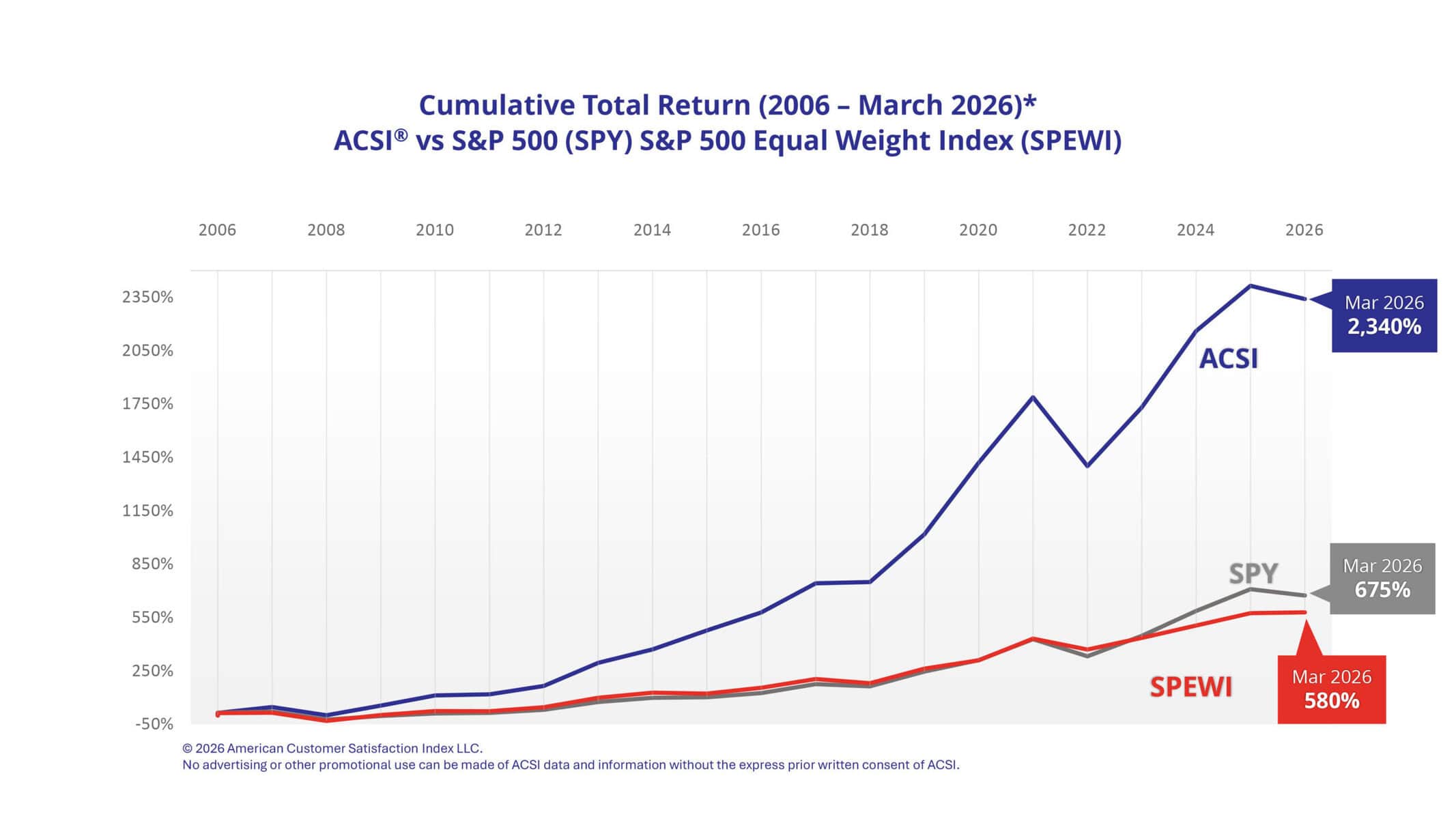
From January 2006 through March 2026, the ACSI Leaders portfolio generated a cumulative return of 2,340%, compared with 675% for the S&P 500 and 580% for the S&P 500 Equal Weight Index (SPEWI). This corresponds to annualized returns of 17.1% for the ACSI Leaders portfolio, versus 10.6% for the S&P 500 and 9.9% for SPEWI.
Over the last five years, the S&P 500 has become increasingly concentrated, as the largest companies have produced an outsized share of earnings growth, reinforced by strong inflows from a growing pool of price-inelastic “passive” investors. The Magnificent Seven stocks now account for roughly one-third of the S&P 500’s index weight and nearly 50% of the index’s total return over the 2024–2025 period. When combined with the downstream impact of AI/data center CapEx cycle, this narrow, sector- and style-specific leadership raises questions about the S&P 500’s suitability as a benchmark for portfolios without meaningful exposure to these largely B2B segments.
When compared with the 2023–2025 performance of the S&P 500 Equal Weight Index - a more appropriate benchmark - the ACSI Leaders portfolio outperformed by 22.8% over the 36-month period (+65.5% vs. +42.7%), while maintaining a low beta (0.84) and defensive characteristics (downside capture: 64), highlighting its differentiated drivers of return.
For the first quarter of 2026, the ACSI Leaders portfolio (-3.0%) outperformed the S&P 500 (-4.3%) by 136 basis points. The Information Technology sector was the largest source of outperformance vs the S&P 500. In addition to being underweight in the sector, ACSI selected Information Technology stocks produces a return of -0.4% vs -9.1% for the broader sector. Consumer Staples (+12.8% vs +7.7%) and Communication Services (-2.8% vs. -6.9%) were the next largest contributing sectors within the ACSI Leaders portfolio. Having no exposure to Energy (+38.3%) – the best performing sector in the S&P 500 during the quarter – was the largest source of underperformance alongside the portfolio’s Health Care allocations (-24% vs -5%).
Abnormal positive returns on customer satisfaction are sensitive not only to relevant benchmarks, but also dependent on competitive markets, where sellers are rewarded for satisfying their customers and punished for failing to do so. While not without temporary interruptions, this has generally been the case in the US and is also a requirement for strong economic growth.
For more information on ACSI as a financial signal, please contact Josh Blechman [email protected].