ACSI Commentary May 2010
|
|
ACSI Results for Utilities, Hospitals, Ambulatory Care, Cell Phones, Computer Software, Fixed-Line and Wireless Telephone Service, Newspapers, Subscription Television Service, TV News, and Motion Pictures
Commentary by Professor Claes Fornell
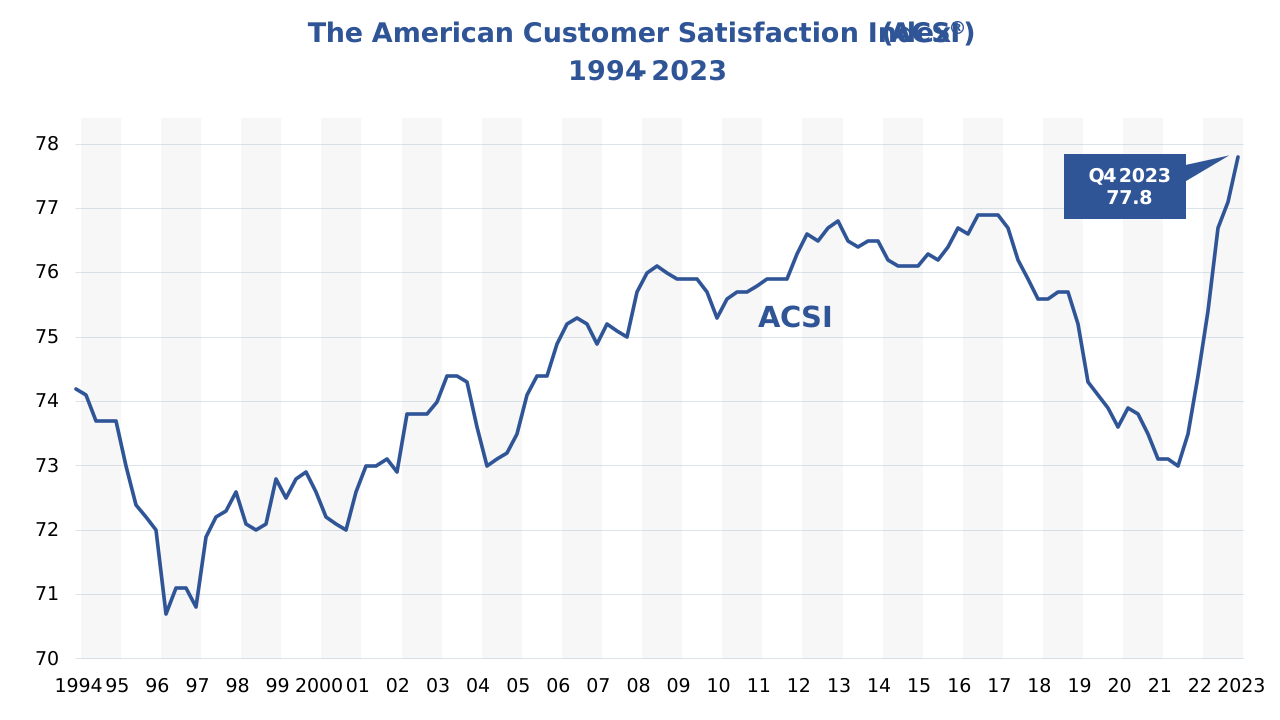
Drop in Hospital Satisfaction Dampens Major Improvements ElsewhereBig Gains for Microsoft, Sprint Nextel, CMS Energy, NiSource, DISH, Charter, Samsung, Motorola, and AT&T; ACSI Gainers Outnumber Decliners by a Wide Margin After the ACSI numbers weakened during the latter half of 2007 through much of 2008, American businesses have responded well to the recession as far as consumers are concerned. Customer satisfaction has increased or stabilized. There have been far more ACSI gainers than losers. Customer service has improved and buyer value for money is rising. The progress in customer satisfaction is also reflected in growing consumer demand—a necessary factor in order to have a sustainable economic recovery. Consumer spending, which continues to account for two-thirds of the economy, increased by a robust 3.6% during the first quarter. Even though the overall index is unchanged at 75.9, almost every industry has improved. Were it not for the slump in patient satisfaction with hospitals, the overall index would be up. Eighty-two percent (82%) of the industries had higher ACSI scores, 9% stayed the same, and 9% had lower scores. Cell phones (+6%), subscription television service (+5%), wireless telephone service (+4%), network/cable TV news (+4%), fixed-line telephone service (+4%), newspapers (+3%), motion pictures (+3%), computer software (+1%), and ambulatory care (+1%) all gained. Energy utilities were unchanged. Hospitals dropped 5%. Among individual companies, gainers outnumbered decliners: 61% improved, 27% fell, and 12% did not change. Over time, there has been a fairly strong relationship between ACSI and consumer spending, but the effect of customer satisfaction on short-term demand tends to weaken somewhat during a recession. Consumer confidence and the ability to spend grow in importance. Nevertheless, we have now seen three consecutive quarters of consumer spending growth and ACSI levels have remained high with more firms improving than declining. Assuming no unforeseen shocks to the economy and continued improvements in labor markets, we should see increased consumer spending of 3.0% to 3.4% in the second quarter. Subscription Televison Service Increased competition is the reason for much of the improvement in customer satisfaction for subscription television service. Although not high compared with other business, customer satisfaction is up by 5% to 66. Having enjoyed near-monopoly status in most areas for many years, cable companies had little incentive to provide quality services at a good price. The satellite companies have taken advantage of cable’s weakness in customer satisfaction and have grown their subscriber base at a rapid rate. In addition, AT&T and Verizon’s emerging fiber-optic TV services now pose even more of a competitive challenge to cable. Consequently, cable providers have now started to step up customer service and realize some gains in customer satisfaction, but they remain far behind both satellite and fiber-optics. Verizon’s FiOS, measured for the first time, comes in on top at 73. AT&T’s U-verse, also included for the first time, is not far behind at 72. Picture quality and low introductory prices have led to not only higher customer satisfaction, but also more subscribers. Although relatively new and still not available in many parts of the country, FiOS and U-verse had about 2.5 and 2 million subscribers by the end of 2009. The two satellite companies, DISH Network and DIRECTV, trail the fiber-optic providers, but continue to beat cable in customer satisfaction. DISH Network moved ahead of DIRECTV for the first time since 2005 on the strength of an 11% ACSI surge, to a score of 71, matching its all-time high, while DIRECTV fell 4% to 68. In part, this seems to be due to pricing strategies: DIRECTV raised rates in February 2010, while DISH held them steady for most subscribers and reduced price for others, creating better value for money in the eyes of DISH’s customers. The company added more subscribers than any other pay television provider in 2009, and has also seen its stock price increase more than competition. Among the cable companies, Charter Communications made the largest improvement, up 18% to an ACSI score of 60, but the company remains at the very bottom of the industry. A downsized Charter emerged from bankruptcy late in 2009 and became profitable in the first quarter. Comcast and Time Warner Cable, the number one and number two cable companies by revenue, had more modest gains, each rising 3% to an ACSI score of 61, while Cox Communications improved 2% to 67 to lead for a seventh straight year among the four largest cable TV companies. Telephone Service—Fixed-line and Wireless Almost all U.S. households have at least one fixed-line telephone number, cell phone number or both, and many have a fixed-line plus multiple wireless accounts. In recent years, the usage of fixed-lines has been trending downward and wireless is on the rise. More than 1 in 5 households have no fixed-line at all, relying solely on wireless, while the number of households that have fixed-line only has declined to less than 20%. AT&T and Verizon now derive more revenue from wireless than from fixed-line services. Driven by strong competition, customer satisfaction with both types of services has improved over the past five years. Fixed-line telephone service gained 4% from a year ago to an ACSI score of 75. Smaller local and long distance providers such as Vonage, Frontier, and Windstream lead the way, up 4% to 78. Because these smaller companies offer only fixed-line services and serve more limited markets, their efforts are more concentrated and may be more customized than the larger companies. Most of the large fixed-line providers also improved. AT&T moved up 6% to a score of 75, closely followed by Cox, unchanged at 74, and Verizon, up 3% to 73. AT&T has been successful with attractive pricing through its unlimited local and long distance plans and bundling of telephone services with DSL Internet connectivity and U-verse television. Qwest Communications edged up slightly, improving 1% to 72, while CenturyLink, a result of the 2009 merger between Embarq and CenturyTel, gained 3% to 70. Comcast, which improved 2% to an ACSI score of 68, remains in last place. Customer satisfaction with wireless also increased, up 4% to 72, setting a new all-time high for the industry for a second straight year. With wireless looking to be the future of telephone service and with escalating competition, companies are ramping up efforts to provide new services, simplified usage plans, and better pricing. Better phones are also contributing to higher satisfaction. The ACSI for cell phones themselves improved 6% to an all-time high of 76, led by big gains for Samsung and Motorola, up 9% and 6% respectively to scores of 76. A third major manufacturer of phones, Nokia, also gained, up 3% to 76. As with fixed-line, the aggregate of smaller wireless providers, including TracFone, Metro PCS, and U.S. Cellular, are at the top, improving 4% to an ACSI score of 76. Among the big wireless companies, T-Mobile gained 3% to a score of 73, tying for the industry lead with Verizon Wireless, which slipped 1%. AT&T’s wireless service, AT&T Mobility, improved 3% to 69. Two years after the introduction of the iPhone as an exclusive product, AT&T seems to have made strides to resolve the strains on its network caused by the rapid growth of iPhone usage. Sprint Nextel had the largest increase, up 11% to an ACSI score of 70, following a year of a similar gain of 13%. The two-year advance has pushed Sprint from considerably below to very close to the industry average. Sprint’s 2004 acquisition of Nextel was probably behind much of its past customer problems—mergers of large service companies are often detrimental to customer satisfaction, and the customers acquired from Nextel had even lower satisfaction than the Sprint customers. In order to stem customer defections, Sprint has relied on price promotions and bundled services. Its “Beyond Talk” combines unlimited text, email, and Internet for $25 per month, the lowest rate in the industry. If customers perceive it as better value for money, Sprint should be able to keep a larger proportion of its current customers. Healthcare Customer satisfaction with healthcare was mixed—up for office visits, down for hospitals. The ACSI for the broad category of ambulatory care improved 1% to 81, while patient satisfaction with hospitals plunged 5% to a score of 73, dragging down the healthcare sector as a whole by almost 2%. ACSI data suggest that hospitals may be reasonably nice places for short visits, but less nice to stay in. Satisfaction with outpatient services remains high, unchanged with an ACSI score of 80, but inpatient satisfaction fell 5% to 74. Satisfaction with emergency room services declined even further, down 12% to 64. A combination of a greater emphasis on outpatient treatments and an increase in the number of after-hours facilities offering alternatives to ERs may help relieve some of the pressure on hospitals and reverse or at least slow the downturn in patient satisfaction. Computer Software The computer software industry is diverse, with hundreds of companies—many of them small—producing applications. Microsoft is, by far, the largest corporation in the industry. It is also the only entity large enough to be included in the ACSI, alongside an aggregated index for the rest of the industry. Customer satisfaction with computer software increased slightly from a year ago, up 1% to an ACSI score of 76—an all-time high. The aggregate of all other software makers leads, up 1% to 77, statistically tied with a much improved Microsoft, up 9% to a score of 76. At the beginning of 2007, when Microsoft released Windows Vista, customer satisfaction plunged 4% to an ACSI score of 70, well below the industry average, where it remained for the next three years. In October 2009, Windows 7 was introduced. It took three weeks for the new software to reach a 4% market share compared with seven months for Windows Vista, as consumers were in a hurry to upgrade. By March 2010, more than 90 million Windows 7 licenses had been sold. Microsoft has achieved high-volume sales from a big boost in customer satisfaction—its ACSI score is Microsoft’s highest ever. Newspapers Reader satisfaction with newspapers improved to a three-year high ACSI score of 65. Still, this is the weakest satisfaction among the 44 industries included in ACSI, and the newspaper business has not done better than the 60s for more than a decade. By contrast, Internet news sources provide much higher ACSI scores. As people find online alternatives more attractive, newspaper readership has continued to plunge, with weekday sales down almost 9% over the past six months. The latest bump in satisfaction for newspapers is most likely a result of accelerating reader defections rather than with the quality of the papers themselves: those readers who leave are probably the least satisfied. The average satisfaction for those who remain is higher—thus the higher ACSI score. Utilities Customer satisfaction with energy utilities, which provide natural gas and electric service to households throughout the U.S., has been holding steady for the past three years with an ACSI score of 74. Prices for gas and electricity have been relatively stable over the past year and moderate weather conditions in much of the country have kept power and heating usage at average levels. Among the individual utilities, results were mixed. Industry leader Sempra strengthened its hold on the top spot, improving 4% to 83, matching the highest-ever score for a utility. NiSource and CMS Energy registered the largest improvements, up 7% to 76 and 75, respectively. Dominion Resources and Reliant Energy also made sizeable gains, up 4% to 75 and 72, respectively. Three years after recording one of the largest single-year drops in customer satisfaction, Ameren continued to rebound, climbing 4% to 71, nearly matching its level prior to the drop. Three utilities moved in the opposite direction. PPL Corporation took a big hit, falling 6% to 74 after a new rate hike took effect in January that raised electricity prices by as much as 30%. Xcel Energy fell nearly as much, dropping 5% to 72, while PG&E regressed 4% to 70. Overall, two-thirds of the utilities either improved or stayed the same. |