Utilities: Transportation & Warehousing;
Information; Health Care & Social Assistance; Accommodation & Food Services
May 19, 2009
Commentary by Professor Claes Fornell
The Donald C. Cook Professor of Business Administration
Director, National Quality Research Center, Stephen M. Ross Business School at the University of Michigan
Rise in Customer Satisfaction Continues – Now Followed by Other Economic Indicators
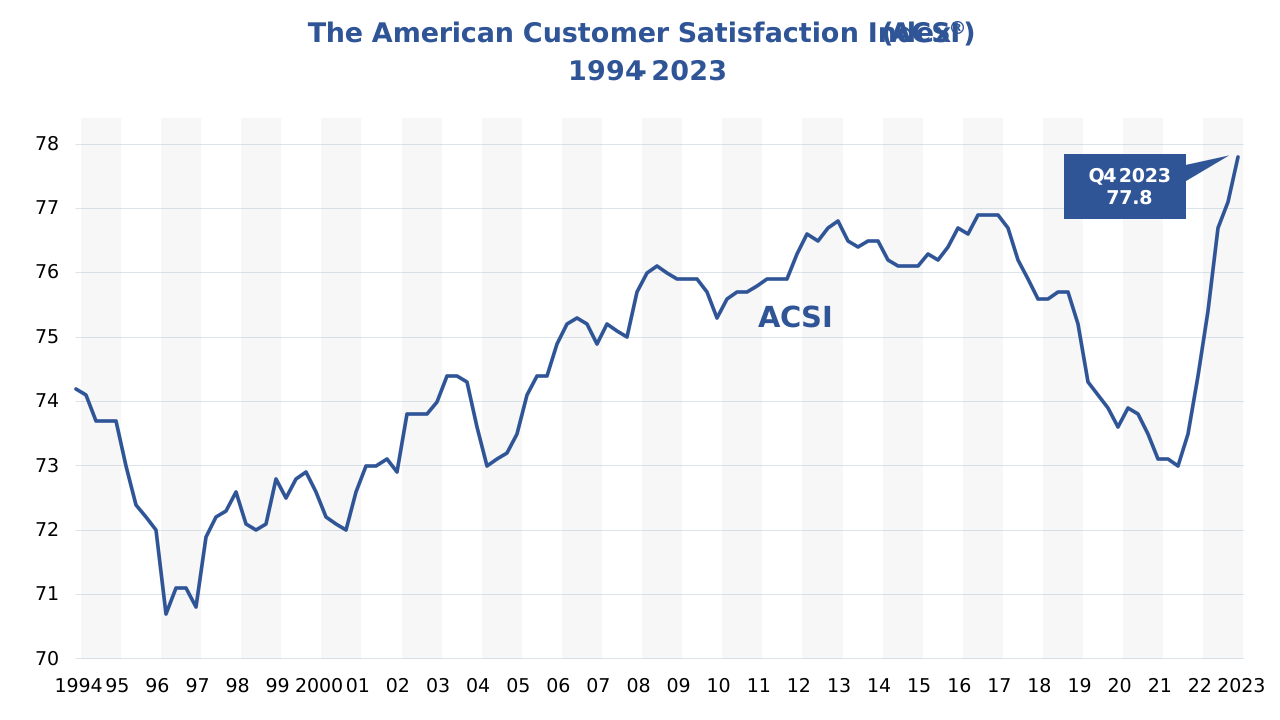
Late last year, after an extended period of mostly declining scores, the American Customer Satisfaction Index (ACSI) was essentially alone among economic indicators to show a positive movement. Because ACSI is often a precursor to growth in consumer demand, it suggested that perhaps the bottom of the recession might not be far away. And contrary to what most economists had expected, consumer spending did rebound in the first quarter of 2009. It is still too early to predict whether or not the recession has bottomed out, but ACSI numbers continue to improve. For the first quarter of this year, the Index is up by 0.4% to a score of 76.0. But now it is also joined by several other economic indicators. Stock prices are rising, real estate is showing signs of life, consumer confidence is up, corporate earnings are mixed but generally better than expectations and inventories are adjusting to demand. Credit markets, wages and unemployment, however, continue to be problematic, but the peak for initial jobless claims may have been reached, according to a recent report by the Labor Department.
As discussed in the previous commentary, for consumer spending to recover and for higher customer satisfaction to translate into more consumer demand, it was not going to be sufficient for consumers just to be willing to spend – households also need to have the means to spend. But even though wages and employment fell, consumer spending rose in the first quarter. When this has happened in the past, credit was used to finance consumption. Today is different. The credit markets are tight and consumers are more inclined to save rather than to borrow money. The spending growth in the first quarter was financed via large increases in government transfers (unemployment insurance payouts, tax refunds and cost-of-living adjustments). These transfers more than offset falling consumer earnings in the first quarter. If the economic stimulus package begins to have significant multiplier effects, consumer demand may well pick up earlier than generally predicted, but it will also depend on to what extent these effects are accompanied by continued financing of consumer spending (e.g. via tax credits and increased Social Security payments) in order to counteract the almost certain continual decline in wages and salaries. As the figure below shows, there is a relationship between ACSI growth in one quarter and consumer spending growth in the following quarter. Analysis of ACSI data, household income, and changes in household debt ratios suggest that a consumer spending increase of 1.5% would be a reasonable expectation for the second quarter of 2009.
Even as the economy recovers, it will be going through a period of dramatic adjustments, many of them driven by changes in information related technology. Some of this has already had an effect. Consider movies and newspapers, for example. Both have been challenged by new technology and the emergence of competing alternatives. In 2000, the movie and newspaper industries had identical ACSI scores. Today, motion pictures enjoy an 18% ACSI advantage and a healthy box office, whereas newspapers are in deep financial trouble. Wireless phones are increasing in customer satisfaction and rapidly expanding their range of services. They were not even included in the ACSI until 2004. Computer software is increasing in customer satisfaction even though its largest supplier, Microsoft, is not. Contrary to popular belief, patient satisfaction with healthcare, (or more specifically, with hospitals) has improved steadily since 2005 – it now boasts an ACSI score of 77, which is 9% higher than in 2005 and above the average ACSI for all industries.
For the first quarter of 2009, customer satisfaction improved for all five sectors covered. The gain was largest for the Information (+2.3%), followed by the Accommodation and Food Service (+2.1%) sectors. Among the industries, 47% had better ACSI scores than a year ago, 29% were unchanged, and 24% declined. Among the companies, 46% improved, 17% were unchanged and 37% declined. For the most part, the gains in ACSI were driven by lower prices, while quality remained the same.
Eating Out – Better Value and Higher Customer Satisfaction
Fast food has done well throughout the recession. The average number of customer visits to fast food restaurants has increased and so has customer satisfaction. Overall, ACSI for fast foods has improved by 13% since 1997 and now stands at a score of 78 – well above the overall ACSI for all industries. Smaller is better. The “all others” aggregate of smaller fast food chains improved 4% to 83, its highest level, to lead the category. Among the larger competitors, Domino’s is on top with a score of 77. The pizza maker has demonstrated a very consistent climb in ACSI after a change in management in 1999. Papa John’s, the former industry leader in customer satisfaction, continues to drop. Since 2006, Papa John’s has shown a small, but steady decline in ACSI. Following recent trends in the pizza business, Papa John’s has expanded menu offerings to include breadsticks, chicken, and desserts. Offering more consumer choice usually leads to higher satisfaction, but only if the new offerings fit the customer base and if quality does not suffer.
After a short-lived slump a few years ago, McDonald’s has consistently improved. Over the past 4 years, its ACSI score has gone up by 13%. Four years ago, it was lagging well below all other fast food restaurants; now it has a higher level of customer satisfaction than Burger King and Kentucky Fried Chicken. Much of this rise has to do with its ability to provide value for money, according to its customers, as well as making beneficial changes in menu offerings. The new coffee products, in particular, have been well received by customers. Wendy’s has also improved. It is up by 4% to an ACSI of 76. Wendy’s joined with Arby’s in 2008, and together added a breakfast menu and a larger selection of value-priced items as it also caters somewhat more to include older customers. Taco Bell too has added offerings, including a new breakfast menu, healthier alternatives, and a new line of frozen fruit drinks. It too saw an increase in customer satisfaction (+4%) to a score of 73.
The recession continues to pose difficulties for full-service restaurants. While consumers have opted for lower-priced fast food, spending at sit-down restaurants has deteriorated. In response, many of these restaurants are using price reductions and menu changes in order to mitigate customer defection. This has resulted in a sizeable increase in customer satisfaction, but only a small increase in customer loyalty - not enough to offset a loss of customers to fast food and dining at home. The full-service category of restaurants improved 5% to an ACSI score of 84, led by a 6% increase for smaller more customized restaurants. Smaller chains are more adversely impacted by the economy and have had to be even more aggressive with pricing and promotions to keep customers. Although down 1% to 81, Olive Garden continues to lead the industry.
Hotels
Hotels are facing a difficult time as consumers and businesses tighten spending on vacations and scale back on conventions and business travel. On the average the industry has not retreated in guest services – customer satisfaction remains steady with an ACSI score of 75. Nevertheless, the results for individual hotel companies are mixed. Unlike previous recessions, the luxury chains have been hit hard this time – here prices as well as quality of service have been cut. This is problematic, because the success of the luxury hotel is a function of great service and reasonably high margins. By contrast, value for money has remained strong for the budget hotels, in part because both prices and service were low to begin with.
Hilton leads the category, up 1% to an ACSI score of 79, closely followed by Marriott at 77 (-1%). Hyatt plunged 5% to 74, its lowest score in five years. Combined with big improvements for Choice Hotels (+7% to 76) and Best Western (+7% to 75) this puts the luxury hotel below two budget chains in guest satisfaction. That’s a position that Hyatt would not want to be in, because its business depends heavily on service quality and the ability to charge for it. Choice and Best Western have kept price promotions, while at the same time offering new amenities such as free Wi-Fi access as well as perks for business travelers (e.g. free access to business and fitness centers). Only Wyndham Worldwide, unchanged with an ACSI of 70, trails Hyatt. The Hyatt brand is more upscale and extended-stay, both of which have suffered the most of late. Both Hilton and Marriott have a broader portfolio embracing luxury, midscale and even occasionally discount brands, something that creates somewhat better insulation in difficult economic times.
What? Airline Passenger Satisfaction Improves?
Passenger satisfaction with airlines improved for the first time since 2003, up 3% to an ACSI score of 64, ending a downward trend that, with few interruptions, began in 1994. High volatility in fuel prices, indifferent service, labor problems, congested airports, and financial challenges have plagued the industry for a long time and even with the current improvement, airlines remain one of the lowest scoring businesses in ACSI.
American Airlines stands out by going in a direction opposite to the other major carriers. Its ACSI score dropped 3% to 60. Southwest Airlines leads for a sixteenth straight year, up 3% to an all-time high of 81. At the other end of the spectrum, United Airlines is unchanged with an ACSI of 56; the 25 point spread from top to bottom is unmatched in any other industry. The key to Southwest’s performance appears to be superior execution of a no-frills approach with discounted fares and reliable service. The airline has a record of being able to deliver the basics well – getting its passengers to their respective destinations on time with their luggage intact. Southwest’s revenue grew by 12% in 2008. Curiously enough, airlines that have had significant customer service problems in the past improved the most. Continental is up 10% to 68, erasing a similar loss from a year ago, and US Airways is up 9% to 59, also erasing a similar decline. Delta improved 7% to 64 in the wake of its merger with Northwest, while Northwest itself remained unchanged near the bottom of the industry at 57, just ahead of United.
US Airways has benefited from its more generous frequent flyer miles and discounts on select flights as well as from a better on-time arrival record, but much of the improvement, not only for individual airlines, but also for the industry as a whole, can be attributed to smaller passenger loads leading to shorter lines, increases in on-time arrivals, less lost luggage, more space availability, and higher steward-per-passenger ratios. ACSI recorded a similar phenomenon after 9/11 when passenger satisfaction climbed by 8%. While it is true for most service industries that customer service tends to get better when there are fewer customers to serve, this is obviously not a positive development – but the alternative would be worse.
Cable/Satellite TV
Viewer satisfaction among subscribers to cable and satellite television declined 2% to 63. Even though there has been improvement among some, it seems difficult to move the ACSI needle much for the industry as a whole. DirecTV appears to be different. It has greatly extended its lead over DISH Network. Just two years ago the two were tied at 67, but now DirecTV stands atop the category, up 4% to 71. DISH fell for a third straight year - down 2% to an historical low of 64.
Because satellite TV companies partner with telecommunications companies in order to offer additional service packages, such as voice and Internet, it is likely that the partner companies have an effect on the satisfaction their customers. DirecTV’s voice partner Verizon is the ACSI leader in its industry, while DISH Network’s partner Sprint Nextel is at the opposite side of the scale. As is typically the case, the health of a company’s customer relationship is reflected in stock price movements. DirecTV’s share price has fallen 19% over the past twelve months, about half the market average. DISH has dropped 61% over the same period.
Among cable TV providers, Cox Communications leads for a sixth straight year and reaches an all-time high with an ACSI score of 66. But Comcast, the largest US cable company in the country, has made an even bigger leap, up 9% to 59. Over the past year, Comcast has used a novel approach in customer communications. The company monitors customer feedback on blogs and via the social networking site Twitter in order to identify disgruntled customers and address customer dissatisfaction on a one-to-one basis. Charter Communications has moved in the opposite direction, down 6% to an ACSI score of 51, a record low for any company in the 15-year history of ACSI measurement. Its stock has been delisted and is trading around a nickel.
Telephone Service – Fixed-line and wireless
A year after customer satisfaction with fixed line telephone service improved for the first time in many years, ACSI fell back slightly, dropping 1% to 72. Smaller local and long distance providers such as Vonage went in the other direction, up 1% to 75, and now lead the industry, followed by Cox Communications, unchanged at 74. In contrast to its gain among cable customers, Comcast loses ground (-3% to a score of 67). AT&T, Qwest and Verizon, all come in at a score of 71. AT&T lost most of the ground it gained a year ago when it surged 7% to an ACSI of 75, capturing the industry lead. Problems with bundling of services, customer service deficiencies, and a slower than expected rollouts of its U-verse television service are among the culprits. While bundling may prove a significant challenge for AT&T and others in the industry, it also offers potential leverage and, if done well, may lead to higher satisfaction for all customers. As the demarcation continues to blur among fixed-line telephone, cable, and Internet providers (at some point in the not too distant future customers can choose from among many different companies offering a combination of all these services), the increase in competition and consumer choice options should lead to higher levels of customer satisfaction.
Customer satisfaction with wireless telephone service increased slightly, up 1.5% to 69, a new all-time high for the category. Verizon Wireless remains on top with a 3% improvement to 74. Sprint Nextel anchors the bottom, but made the biggest ACSI gain of any company measured in the first quarter, up 13% to 63. A good part of this increase, however, is probably due to the fact that many dissatisfied customers have defected. Sprint showed a larger loss than expected in the first quarter and reported high rates of customer defections. As the company lost its least satisfied customers, the somewhat higher average satisfaction among the remaining customers probably led to a higher overall ACSI score. In order to stop further customer losses, Sprint is taking steps towards a more customer focused strategy, improving its website, enhancing training among its customer care staff, and offering the most comprehensive and simplified combination of wireless services in the industry where customers can get voice, data, text, Sprint TV, GPS and more for what appears to be a competitive price. Perhaps these efforts will continue to move customer satisfaction further.
AT&T’s wireless service, AT&T Mobility fell 6% to 67. Paradoxically, AT&T Mobility’s success with the iPhone may have contributed to declining customer satisfaction. Many of the new customers are different from the regular AT&T customer in that they seem to have more data-intensive needs. The problem is not the iPhones themselves, but rather that the influx of new users seems to have strained AT&T Mobility’s network and there has been a number of complaints about network performance.
Utilities
Customer satisfaction with utilities remains unchanged with at an ACSI score of 74. Although unchanged, Sempra Energy led the industry with an ACSI of 80. MidAmerican Energy (+1%) and PPL Corporation (+1%) follow closely at 79. At the other end of the spectrum, three utilities are now below 70. Pepco Holdings declined 1% to a score of 68, while Ameren improved by 6% also to a score of 68. Consolidated Edison anchors the bottom of the industry at 66, unchanged from last year.
For an industry where there is little or no competition over household buyers and where basic service itself is fairly straightforward, the ability to restore power when outages occur as a result of storms and other events becomes a key component of the quality of the experience. Those utility companies that improved the most in ACSI also did a better job of informing its customers about power disruptions, fixing black-outs, helping improve energy efficiency, and simplifying billing.
|