Retail Trade; Finance & Insurance; E-Commerce
February 17, 2009
Commentary by Professor Claes Fornell
The Donald C. Cook Professor of Business Administration
Director, National Quality Research Center, Stephen M. Ross School of Business, University of Michigan
Chairman, CFI Group
ACSI Rises as the Economy Weakens - What Does it Mean?
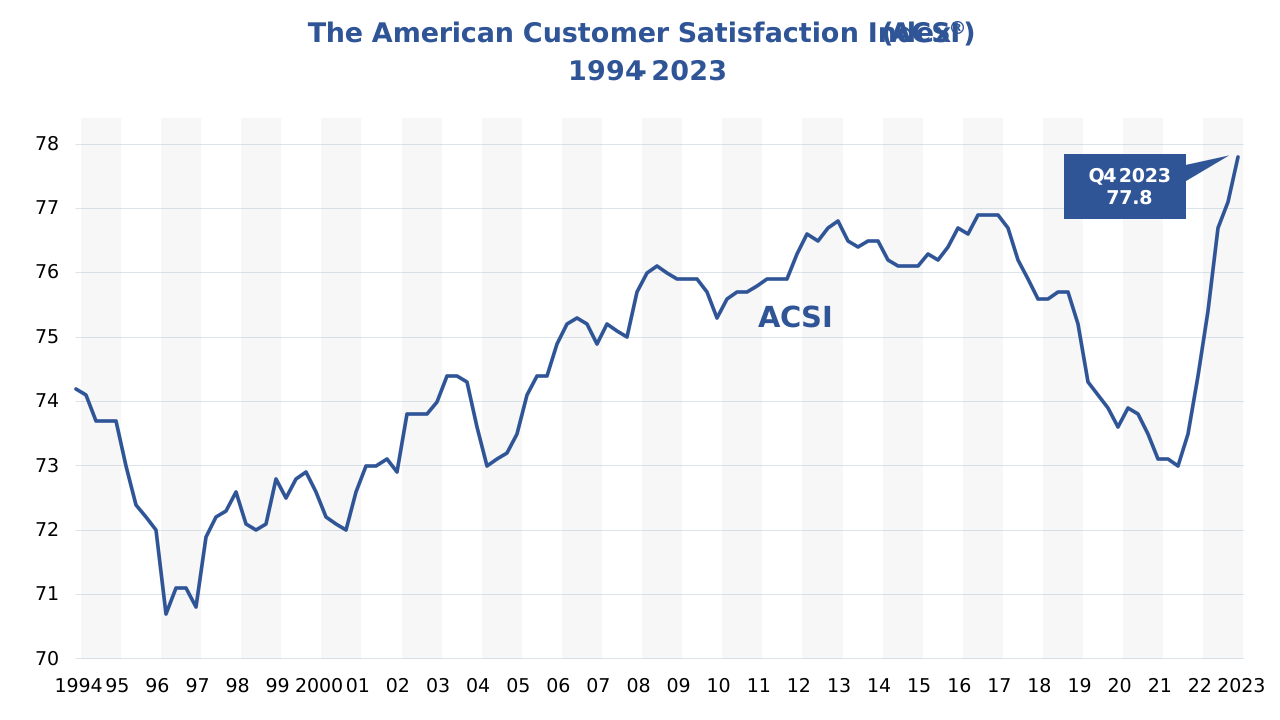
Very few economic indicators show positive signs these days. The American Customer Satisfaction (ACSI) is one of them. After a year and a half of a downward trend, ACSI turned upward in the fourth quarter of last year, improving 0.9% to 75.7. What does this mean? Let's take a look at the past data. In the fall of 2007, prior to the onset of the recession in December, ACSI began to decline. The same pattern emerged during the 2001 recession. ACSI fell before the recession began and rose as the rebound was near. So the question now is: will the current ACSI spike be as predictive of where the economy is heading?
As this recession has deepened, consumer behavior has changed much more than in most other economic contractions. Consumer spending has weakened considerably while household savings have risen. For the immediate future, the implications are clear. There will be less revenue for sellers and more pressure on profit margins and cost-cutting. More jobs will be lost. For consumer spending to rebound, at least two conditions must be met. First, consumers' expectations about the gratification from future discretionary spending must be high and/or rising. The good news is that this condition is met. The bad news is that in order for strong customer satisfaction to translate into demand, it is also necessary that consumers have the means - cash and credit - to spend. Thus far, this condition is wanting. As long as this remains the case, the power of ACSI alone to predict consumer spending will be diluted. It does not mean, however, that customer satisfaction becomes less important in recessions. On the contrary, it takes on an extra dimension.
At the micro level, the first priority for any company should be to defend its customer base. Without it, the prospects for the future would be bleak. It will obviously also be in the public interest to see what happens to product quality, service and customer satisfaction for those companies that have received taxpayer money. For example, the lowest scoring cars in the auto industry are all domestic nameplates; the highest scoring are all imports. For the government bailout of GM and Chrysler to be effective, this picture must change. ACSI results for automobiles will be released in August. If there is no change for the better by then, it will probably be more difficult for the auto companies to argue for additional financial support.
At the macro level, ACSI can be used to assess whether or not the economic stimulus package is working. One of the most important lessons from the Great Depression is that the fiscal stimulus did not have the desired effect, mainly because it created collusion and monopoly power. Such power has adverse effects on customer satisfaction and buyer value for money, as it erodes the business incentive to compete for the satisfaction of its customers. Lack of competition also makes it more difficult for economic recovery as it impedes productivity and weakens the nation's ability to do well in the global economy. As the stimulus package begins to take effect, it will be very important to monitor its impact via changes in customer satisfaction as an indicator of the quality of economic output, as judged by the actual users of products and services.
Of the 12 industries covered by ACSI in the fourth quarter, 5 improved, 4 did not change and 3 declined. With rapidly falling fuel prices, gasoline stations led all gainers with an improvement of 5.7%. At the other end of the spectrum, customer satisfaction with brokerage firms (online) deteriorated by 6.3% in the wake of large losses in equity markets. Banks, faced with major financial challenges, also fell (-3.8%). At the firm level, the results were mixed: 45% of the companies improved, 16% did not change, and 39% saw falling ACSI scores.
The graph below shows the historically strong relationship between ACSI changes and future consumer spending growth. This relationship is not likely to remain as strong unless or until the stimulus package begins to have a major effect.
Retail
Customer satisfaction with the retail sector is up 1.3% to 75.2. Falling gas prices are a major reason as customer satisfaction jumps 5.7% to an ACSI score of 74 for service stations. Department and discount stores (+1.4% to 74) and specialty retail stores (+1.3% to 76) also contribute. But even with increasing levels of customer satisfaction, most retailers are facing a very difficult time. Sales during the holiday season plunged. It is important to understand that a good part of the sales decline was due to falling prices. For example, gasoline sales fell by 16% in December, but price dropped by more than 50% over the year. Overall retail sales dropped no more than 0.1% in 2008 according to the Commerce Department. When price reductions are factored in, that number is no longer negative. This is not to suggest that things are not bad. They are very bad, but sometimes interpretations of economic data are also a bit exaggerated.
While lower gas prices caused the ACSI increase for service stations, and price reductions in general prevented consumer demand from an even worse free fall, price actually played a somewhat lesser role for customer satisfaction in some of the retail business. Despite heavy discounting during the holiday season, the bulk of the improvement in ACSI was actually due to better customer service. It is likely that sales staff tried harder to please customers because of the economic situation and fear of unemployment. It is also possible that store traffic decreased to the point that there were more personnel per customer than usual. Both effects are rarely sustainable and will be even more difficult to build on as many retailers have since eliminated more jobs.
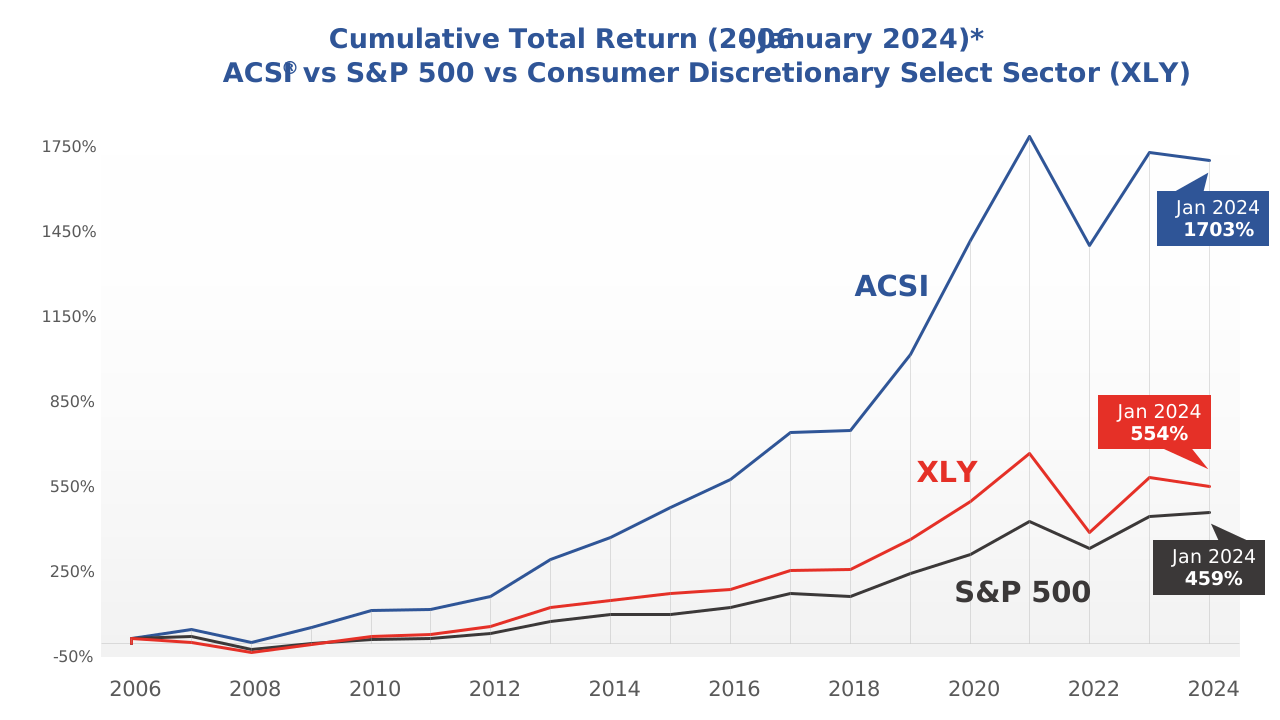
For most retailers, stock prices fell sharply over the past year, but those companies that improved customer satisfaction were punished less. For example, Borders dropped 3% in ACSI; its stock price tumbled by 96%. Office Depot lost 4% in ACSI and 79% of its stock price. On average, retailers that gained in ACSI lost about 30% of their market value in 2008, while those with declining ACSI scores lost nearly twice as much (57%) over the same period. By comparison, the S&P 500 dropped by 38%.
Supermarkets
The supermarket category remains unchanged from 2007 despite the fact that food and beverage prices increased. Grocery prices rose 6.6% in 2008 compared with a 5.7% increase in 2007, both the highest single year increases since 1980. Yet supermarkets appear to have been able to absorb these increases without suffering any negative effects on customer satisfaction by improving the quality of the shopping experience through redesigned stores, better variety of merchandise, and longer hours. For 2008, a small drop of 1.3% in value for money was offset by a 2.6% increase in quality, keeping customer satisfaction with the industry stable.
Several supermarkets improved, among them Safeway (up 4% to 75), moving from one of the lowest levels to close to the industry average. The third largest grocery chain in the U.S. has invested in creating a new store format called the Lifestyle store, featuring more square footage to accommodate expanded selections of perishables, organic foods and other merchandise. Nearly three-quarters of all Safeway stores have been upgraded to date and 90% should be converted by the end of 2009. Other chains that made more modest gains include Kroger, Whole Foods and Winn Dixie, all up 3% to 77, 75 and 73 respectively.
Publix's slogan, "Where Shopping is a Pleasure," appears well justified. One of just two companies in the fifteen year history of ACSI to lead its industry each and every year (the other is Southwest Airlines), Publix is also one of the few companies outside of manufacturing and e-commerce to consistently maintain an ACSI of 80 or better. Its current score is 82, down slightly from an all-time high of 83 a year ago, but much higher than any other company in its category.
In the supermarket category, Wal-Mart, represented largely by its Supercenters, continues to be an exception to the rule. The largest food store in the country remained at the bottom in ACSI for a fifth straight year. Its score dropped 4% to 68, an all-time low and the lowest score ever for any chain in the supermarket category. But Wal-Mart competes on price and less on customer satisfaction. Although price has a positive effect on satisfaction, it is dwarfed by quality of service and quality of merchandise. But in a recession, price becomes a more important driver of demand. Wal-Mart is one the few retailers with increasing sales. The company also registers improvements in customer satisfaction in its non-grocery discount store business. Increasing customer satisfaction (except in the food business) and unbeatable prices make Wal-Mart an awesome force in a struggling economy.
Department & Discount Stores
Even as retail sales slumped for six straight months to close out 2008, department and discount stores managed to eke out a slight gain in ACSI, up 1.3% to 74, caused almost entirely by a small improvement in customer service. Two very different types of retailers topped the list with an ACSI score of 80: the upscale department store Nordstrom and discounter Kohl's. Both have a long history of high levels of customer satisfaction, with Nordstrom emphasizing superior customer service, and Kohl's offering brand names and exclusive merchandise at low prices.
Deep discounter Dollar General dropped the most - by 4% to a score of 75. Shoppers at Dollar General are attracted to its simple, bare-bones stores where prices are always low, but quests for particular merchandise are hit-or-miss. The reason for the drop in ACSI has less to do with service, quality or availability of merchandise, but much to do with changing demographics. Over the past year there has been a migration of a higher socio-economic group of consumers to Dollar General - another effect of the recession - and these customers tend to be harder to please and have higher expectations.
Specialty Retail and Health & Personal Care Stores
The ACSI for the category of retail stores selling specialized merchandise such as books and music, office supplies, or home improvement items improved 1.3% to 76. Barnes & Noble led among the books and music sellers. Costco was at the top in the warehouse club category. Both have an ACSI score of 83. But this was not enough to offset the slump in consumer spending and the continued migration of shoppers towards the lowest price possible.
The ACSI scores of the office supply retailers fell. Staples and Office Max posted a modest retreat, while Office Depot dropped a sizable 4%. Poor customer service and problems with product availability were the most common consumer complaints. Dissatisfied customers have inflicted much punishment on Office Depot. The company will close more than 100 stores over the next few months in an effort to avoid bankruptcy. Investors are not happy either: stock price declined 79% in 2008, twice the size of the market slump.
Home improvement retailer Home Depot has bounced up and down in ACSI over the past five years as the company has tried to reorganize and reinvent itself. On the positive side, its ACSI recovered in 2008 from an all time low, up 5% to 70. On the negative side, it wasn't enough to lift Home Depot from the bottom in customer satisfaction, marking the seventh consecutive year that it trails Lowe's (+1% to 76) by a wide margin. Service quality remains the worst among all retailers.
Customer satisfaction with health & personal care stores was unchanged at 78, the highest score among the retail categories in ACSI. As usual, the smaller drugstores did better than the big chains and led the way with an ACSI score of 80. Rite Aid has been the laggard in the category for the past four years, and even with a 4% ACSI improvement it remains in last place. The company acquired Brooks Eckerd, the fourth largest drugstore chain, in 2007. With integration completed by mid 2008, it boosted revenues by increasing the size of the company nearly 40% and added a portfolio of more satisfied customers to boot. However, Rite Aid's pattern of rapid growth in recent years has been costly: the difficulty of integrating many stores while closing underperforming ones has sapped earnings, stock value has plummeted and some of its stores are now being sold to competition.
Finance & Insurance
The finance and insurance sector, including commercial banks and property, life and health insurance, improves 0.7% to 76.0, erasing a corresponding deficit from a year ago. Banks fall (-3.8% to 75), but a rise in ACSI for healthcare insurance (+2.8% to 73) and a more modest gain for property & casualty insurance (+1.3% to 81) more than offset the bank decline. Satisfaction with life insurance is unchanged. A new ACSI measure of satisfaction with credit unions debuts much stronger than banks with a score of 84. Credit unions are typically smaller than most banks, and their higher satisfaction follows a pattern in many ACSI industries where smaller companies tend to offer a better quality experience.
Banks
In the fourth quarter of 2007, customer satisfaction with banking reached an all-time high ACSI score of 78, even as the subprime mortgage crisis was beginning to take a toll on many financial institutions. As ACSI covers satisfaction with checking, savings and personal loan accounts, mortgages had probably not yet had an impact on the quality of these banking services. A year later, the picture is quite different. Banks' customer services are no longer free of stress as companies have cut costs across their entire range of services in order to offset large financial losses. Branch closings and staff reductions often have adverse effects on customer satisfaction and customer relationships. In addition, mergers and acquisitions have returned - something that often bodes trouble for customer service. During the 1990s, it was a matter of big banks wanting to become bigger; now it is about staving off bankruptcy, with Wells Fargo acquiring Wachovia and JP Morgan Chase purchasing Washington Mutual, to name two.
Wachovia is an example of a good bank gone bad. It is also a reminder of the fact that strong customer satisfaction and great customer relationships cannot protect a firm from the consequences of taking too high a financial risk. Wachovia contracted much of its subprime troubles when it acquired Golden West Financial in 2006 at the height of the housing bubble. Massive losses forced Wachovia to layoff staff - many in the customer service frontline. Because the Wells Fargo acquisition was not completed until the end of the fourth quarter, ACSI included Wachovia for the final time in this release. Remarkably, it still leads in customer satisfaction even though it tumbled by 4% to a score of 76, its lowest level since 2003. Wells Fargo gained 4% to 72, equaling its all-time high and moving the bank out of the industry basement it had shared with Citigroup (unchanged at 69). Wells Fargo has been successful cross-selling its financial products. The average among financial institutions is about 2 products per customer, while Wells Fargo has achieved an average of about 5 products for each customer.
E-Commerce
The e-commerce category, including retail, brokerage and travel websites, retreated from its all-time high in 2007, dropping 2.0% to 80.0. Retail websites declined for the first time since 2004 (-1.2% to 82), while travel websites were unchanged. Not surprisingly, brokerages were the major culprit behind the declining ACSI for e-commerce, falling 6.3% to an ACSI score of 74, the largest drop in any category covered in the fourth quarter.
Online Retail
The small decline in customer satisfaction with online retail was driven mostly by downturns for two of the biggest players. Amazon fell 2% to 86, relinquishing the top spot in the category for the first time in the nine-year history of e-commerce ACSI measurement. Yet Amazon keeps doing exceedingly well in customer satisfaction. Of all companies covered in the fourth quarter, only one - Newegg at 88 -h a higher score. Amazon was also one of the few retailers, along with Newegg, that did well over the holiday season. Sales were up by 18% and the number of units shipped was at an all-time high. With so many transactions, chances are that there were more slip-ups that contributed to the drop in ACSI. Newegg was not affected by such problems. Founded in 2001, Newegg is an online computer hardware and software retailer with a reputation for doing well in response time and consistency of service. Based on its high and increasing customer satisfaction and rapid growth, Newegg may well become a serious competitor to Amazon and e-Bay. It recently launched a new online retail front called Neweggmall.com, offering everything from clothing and jewelry to furnishings and hardware.
Netflix is another strong ACSI performer. With a score of 85 and the addition of online streaming of DVDs to its fast growing subscription base, it is emerging as a strong competitor to Blockbuster and Apple. The company's earnings have been robust and its stock price has gone up as well.
For eBay the news is more troublesome. Its ACSI score fell by 4% to 78, a record low for the company, 11% below Newegg and at the bottom of the online retail category. Much of the decline in customer satisfaction appears to be related to complaints about its system, prices, seller defections and the fact that its auction-based business model seems to have lost some of its luster. Revenues fell 7% in the fourth quarter, marking eBay's first ever negative year-on-year quarter, and stock price declined almost 60% in 2008.
Online Brokerages
As equity prices fell sharply in 2008 and brokerage firms were unsuccessful in preserving capital invested by their customers, the online brokerage ACSI also plunged. The category dropped 6.3% to 74, the lowest level since 2002. While customer satisfaction with online brokerage services fell, value for money, as perceived by clients, fell even more. Brokerages charge fees on the premise that they will provide investment returns superior to the average investor. If they don't, they have provided no value for money.
The larger full-service investment brokers Fidelity and Charles Schwab did much better in terms of customer satisfaction compared with the smaller firms that attract more self-directed investors, like Ameritrade and E*Trade. Even though most investors lost money in 2008 and much of it in the 4th quarter, the ACSI scores for Fidelity and Schwab, while declining, remained high at 80 and 78, respectively. Ameritrade and E*TRADE were far behind at 71 and 69. Ameritrade endured one of the largest one-year ACSI plunges ever. A year ago, it was slightly behind Schwab and Fidelity; for 2008 it fell 11% to a score of 71. One of the largest money market funds, The Reserve, in which it was heavily invested, dropped below $1 per share and froze assets of thousands of clients.
|