First Quarter 2008
|
Utilities: Transportation & Warehousing; Information; Health Care & Social Assistance; Accommodations & Food Services
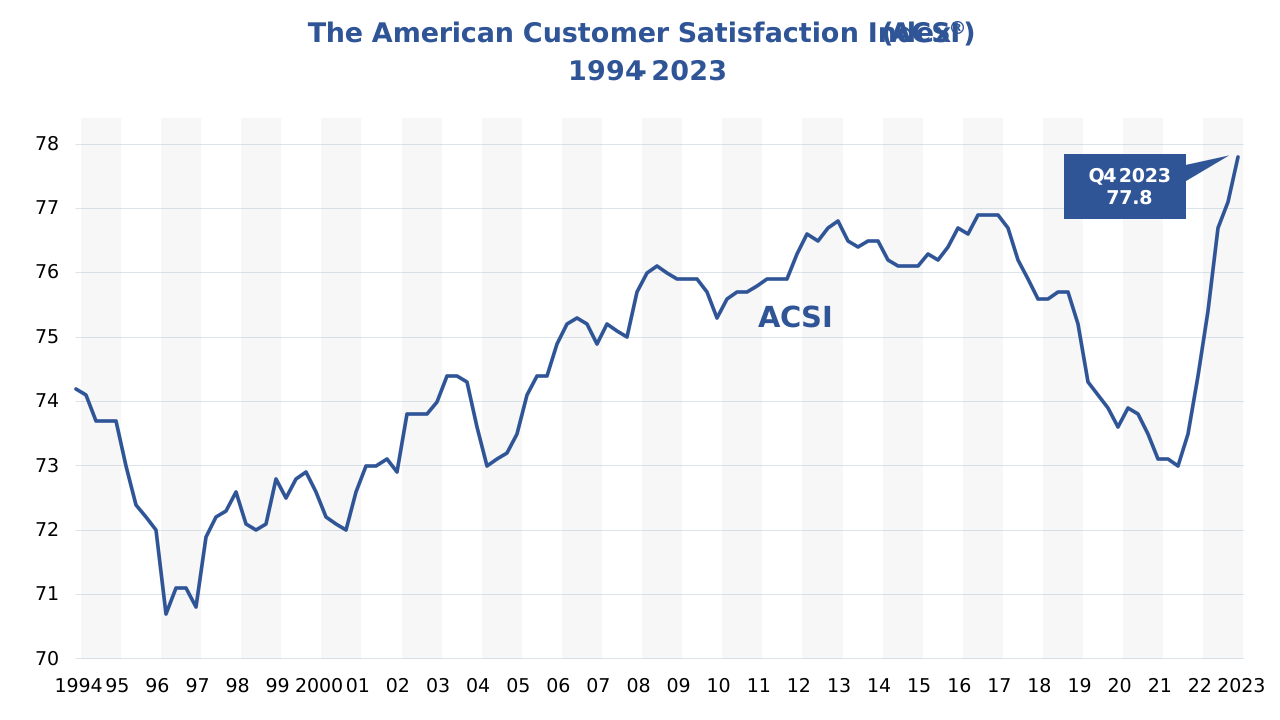
May 20, 2008 ACSI Reverses Course - Many Companies Strengthen Customer RelationshipsMcDonald's, Pizza Hut, AT&T, Embarq Gain;Airlines Fall Again; Sprint Nextel and Wendy's Tumble One year ago, this commentary pointed to a slowdown in ACSI growth. The following quarter saw ACSI flatten and then decline for the final 6 months of 2007. In fact, it was similar to what happened during the economic slowdown in 2000 and 2001. By the last quarter of 2001, both ACSI and GDP had large upswings - which began as a modest ACSI improvement 6 months earlier. Are we in the same situation today? For the first quarter, ACSI climbs for the first time in a year - up 0.4% to 75.2.
But it is uncertain what effect the higher levels of customer satisfaction will have today. The economic challenges are different than they were 8 years ago. There is deflation in housing and inflation in fuel and food, tougher credit conditions and an uncertain labor outlook. Because household savings continue to be meager to nonexistent and real pay is actually falling for many people, higher customer satisfaction might not have the same impact on consumer spending (and thus the economy) as it has had in the past. It may make people more inclined to buy, but if both cash and credit are wanting, it is difficult to see where the means to buy will come from. Since the beginning of 2007, consumer spending has grown no more than 2.8% on an annualized basis in any given quarter. This is also what ACSI forecasted spending growth for the first quarter this year to be. Actual spending growth turned out to be only 1%. The ACSI forecast for the second quarter also suggests tepid growth between 2% and 3%, but that assumes that consumers can find the money to spend - an increasingly tenuous proposition. Even though the macro impact of higher customer satisfaction might be smaller than usual, that is not the case for the micro side. As overall consumer spending weakens and the economy takes a downturn, companies try to make sure that they keep the customers they have. More effort gets devoted to customer retention and less to acquisition. In other words, preservation and customer protection become critical. As a result, we should see a rise in customer satisfaction, unless corporate resources are too depleted or misallocated. This is what the first quarter ACSI data reflect. At the industry level, gainers lead decliners: eight improve (energy utilities, express delivery, broadcast TV news, fixed-line telephone service, cellular telephones, cable & satellite TV, hotels, and fast food restaurants), five decline (airlines, newspapers, computer software, hospitals, and full service restaurants), and two are unchanged (wireless service and motion pictures). Among individual firms measured this quarter, 57% improve and 34% decline.
Surge for McDonalds, but still Last Burger King also improves. While McDonald's is flirting with the idea of serving high quality coffee and has also added healthier menu items, Burger King seems to be sticking with the traditional hamburger fare celebrating the 50th anniversary of its flagship product "the Whopper" and having strong revenues to boot. McDonald's has also demonstrated an ability to sustain the rise in commodity prices, as evidenced by strong earnings, albeit at the expense of a small decline in same-store sales. Both companies have had a good run in the stock market over the past year. In addition to McDonald's, Pizza Hut improves 6% to 76, closing the long-standing gap to Papa John's. Included for the first time last year, full service restaurants drop slightly this year, down 1.2% to 80. This is troublesome because these restaurants are especially vulnerable to competition from fast food during difficult economic times. Outback Steakhouse and Chili's might be especially exposed, Outback because of its 4% slip in ACSI and Chili's because of its 3% fall and very low score. At an ACSI of 73, Chili's is well below the average not only for full service restaurants, but it is below fast food as well. Chili's parent Brinker International, which also operates Romano's Macaroni Grill, has seen its stock price fall 30% over the past year.
Gains in Guest Satisfaction for Smaller Hotels Just as luxury automobile nameplates (e.g. BMW, Lexus, and Cadillac) have consistently led the auto industry over the years, the higher-end hotel chains usually have the highest guest satisfaction - Marriott, Hilton, or Hyatt has been at the top of the ACSI hotel category each and every year. Budget hotels are at the other end of the scale. This reflects the relatively weak effect of price on customer satisfaction. An inexpensive hotel room does not guarantee satisfaction. Often, it is the other way around. Best Western comes in at a score of 70. Choice Hotels (Comfort Inn, Quality Inn, and Econo Lodge) is slightly higher, but close to the brands operated by Wyndham Worldwide (Ramada Inn, Days Inn, Howard Johnson, Super 8) at 70.
Southwest: King of the Skies Southwest Airlines is gaining market share from United and US Airways, both with abysmal passenger satisfaction at 56 and 54, respectively. US Airways is down 12% to a new low and suffers the biggest drop in the industry this year. It is in a free fall of 25% since 1994. The airline emerged from bankruptcy in 2005 and was profitable in both 2006 and 2007, but at the expense of passenger service - complaints are up 10% from a year ago. United and US Airways are contemplating merging forces. Mergers have often been bad news for customers and, subsequently, for shareholders as well. A merger of the weakest of competitors faces even steeper odds. Adding one group of dissatisfied customers to another group of dissatisfied customers rarely sums to a positive. It might even be helpful for competition, especially for Southwest - the only domestic airline that usually gets both passengers and luggage to the same destination and on time, to boot. Continental Airlines also shows a large deterioration in passenger satisfaction - down 10% to 62, a score that matches its all-time low. Northwest tumbles 7% to 57, its lowest score since 2001. Both carriers have cut costs and raised prices to offset the rising price of jet fuel. Passengers are paying more for less and are not happy about it. Northwest is about to be acquired by Delta (up 2% to 60), and the combined company will become the largest domestic carrier if the merger goes through. But it must be prepared to address a large group of disenchanted passengers, who would probably rather defect if they had an alternative.
Cable/Satellite TV: A Blurry Picture The reason for the industry's uptick is the large improvement among smaller cable TV providers such as Cablevision and RCN. The category of "all other" cable TV companies is up 5% to lead the industry with an all-time high of 69, well ahead of the large competitors. As is often the case, small is often better in terms of being able to provide good customer service. Cablevision, for example, with some 3 million subscribers, is barely 1/8th the size of Comcast. These companies don't generally seek to expand quickly beyond their geographic footprints and are often targets of acquisition by larger firms, companies that may be able to withstand depressed customer satisfaction in the short term as operations of the smaller providers are integrated.
AT&T Dials It Up - Sprint Nextel Wilts AT&T has probably benefited from the influx of customers from Bell South, which merged with AT&T in 2006, adding more than 20 million to AT&T's customer portfolio. Bell South had strong customer satisfaction and, with the exception of 2005-2007, AT&T has had a history of customer satisfaction leadership as well. Customers seem to appreciate seamless combinations of traditional local and long-distance services with wireless service. AT&T provides an internet phone service, CallVantage, through its Unity Plan; Cox has launched a wireless phone service; Embarq, after spinning off from parent Sprint, offers an integrated mailbox for wireless and land-line phones so customers only need to check one voicemail. Embarq also allows customer to receive wireless calls on a fixed line and vice versa. Comcast's IP-enabled voice service offers customers unlimited direct-dial local and domestic long-distance calling. As local phone business shrinks with the rise of Internet and wireless communications, the strategy of combining landline and wireless appears to have a positive effect on customer satisfaction. Customer satisfaction with wireless telephone service remains at an all-time high for the second consecutive year at 68, but two of the industry giants are heading in opposite directions. AT&T Mobility gains 4% to a score of 71, while Sprint Nextel plummets 8% to 56, its worst performance to date and well behind all other competitors. AT&T's success may be attributed to making wireless a core business, along with integrating wireless and land phone services. AT&T became the first to let customers to use cell phones and other devices from different manufacturers. The partnerships with Apple (iPhone) and Yahoo! have also led to a wider market reach. Sprint Nextel continues to suffer from service problems and customer defections. After cutting 5,000 jobs from its workforce in early 2007, the company announced another 4,000 layoffs in 2008, along with plans to close 10% of its retail shops. This kind of cost-cutting usually comes at the expense of customer service. With a shrinking customer base and lower earnings and three years after the acquisition of rival Nextel, another merger is in the works. This time with the wireless ISP Clearwire in order to create the first nationwide high-speed wireless broadband network.
Health Care: High Patient Satisfaction Ambulatory care, a new entry to ACSI, has even higher patient satisfaction. At 81, it has one of the highest ACSI scores of any industry - bested only by express delivery (at 82), (which benefits from customer satisfaction stalwarts FedEx and UPS) this quarter. Ambulatory care includes office visits with all types of healthcare professionals, such as physicians, dentists, optometrists, chiropractors, and physical, occupational and speech therapists.
An Uneven Utility Industry In the midst of large variations in customer satisfaction across utilities, customer satisfaction over time has been quite stable for most utilities, with the exception of Ameren and PG&E. Over the years Southern, Progress and American Electric Power have generally done well in ACSI. Consolidated Edison, Northeast Utilities, and Energy Future Holdings have done less well. The development of renewable alternative energy sources - a response to consumer demand for more environmentally-friendly energy - seems to be paying off in increasing customer satisfaction. Reliant Energy is offering residential customers the opportunity to buy a 100% wind power plan at the same rate as the traditional power plan. Its ACSI score is up 12% to 72. Energy Future Holdings Corp., formerly TXU, gains 9% to 68. In early 2007 the company was acquired by a private-equity consortium in what was seen as a landmark for the environment: the company will terminate two-thirds of its proposed coal-fired plants in a plan to reduce overall emissions of key pollutants by 20%, double its wind-power purchases, and invest more in energy efficiency programs.
Newspapers: More Bleeding |