The American Customer Satisfaction Index - The voice of the Nation's Consumer
Fourth Quarter, 2007

Fourth Quarter, 2007


Print

Retail Trade; Finance & Insurance; E-Commerce
February 19, 2008


Commentary by Professor Claes Fornell
The Donald C. Cook Professor of Business Administration
Director, National Quality Research Center, Stephen M. Ross School of Business, University of Michigan
Chairman, CFI Group

Customer Satisfaction Falls Again; Retail, Financial Services Down; Wal-mart, Home Depot at All-Time Lows

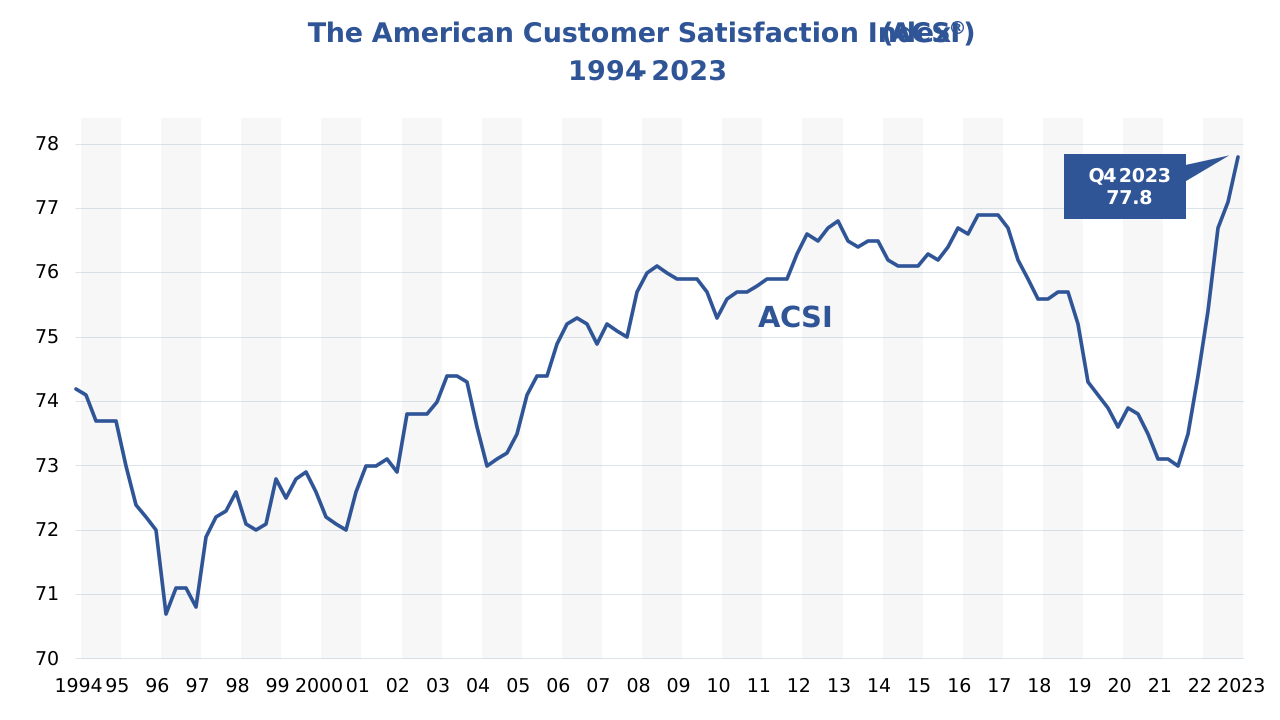
The American Customer Satisfaction Index (ACSI) declines for the second consecutive quarter. For the fourth quarter of 2007, the Index drops .4% to 74.9, the lowest score of 2007. q4_07_comm_chart1 Although aggregate customer satisfaction is declining, of the 12 industries measured in the fourth quarter, 4 improve, 3 are unchanged and 5 decline. But the decliners drop more than the gainers improve. Health insurance, department & discount stores, e-Travel (travel websites), life insurance and gas stations all decline by an average of 1.4%. Results are mixed at the company level as well, with 44% of the companies improved, 13% unchanged, and 43% registering a decline.

The big question for the US economy and, to a considerable extent, for the world economy, is how consumer spending will be affected by a barrage of problems, including increasing unemployment, plummeting house prices, tightening of credit, high levels of household debt, increasing cost of energy, and now also less customer satisfaction.  Consumer spending is the largest component of US GDP and it is particularly sensitive to changes in customer satisfaction and household debt ratios. When customer satisfaction declines, consumers have less enthusiasm for repeating experiences that no longer provide the same gratification.  The experiences in question are the matters relating to shopping, buying, and consuming.   If satisfaction affects consumers' willingness to spend, household debt ratios to income affect consumers' ability to spend.

q4_07_comm_chart2

Debt is up and satisfaction down. This does not encourage spending growth. In fact, the situation is reasonably similiar to what we had in third quarter of 2007. ACSI dropped and household debt grew. The ACSI systems of equations, looking only at  changes in customer satisfaction and household debt ratios, forecasted a slowing of spending growth to 2.5% for the 4th quarter. That turned out to be reasonably close to reality, slightly higher than the Bureau of Economic Analysis preliminary estimates of 2.0%. Assuming the pattern of relationships between ACSI and spending remains intact, spending growth will continue to weaken during the first quarter this year. Again, without even considering the possible effect of unemployment, credit availibility or housing prices, ACSI points to a spending growth of no more then 2.3%.

Retail
Overall, customer satisfaction with the retail sector is down (- .3% to 74.2). Supermarkets are up (+1.3%), while department and discount stores (-1.4%) and gasoline stations (-1.4%) decline. The ACSI scores for specialty retail stores and health and personal care stores remain the same as they did a year ago.

Supermarkets: Publix Bags the Top Spot for the Fourteenth Straight Year
The supermarket ACSI results illustrate an important finding that may seem perplexing at first glance:  Higher prices AND higher customer satisfaction.  Food prices rose at twice the rate of overall inflation in 2007, yet customer satisfaction with supermarkets strengthens by 1.3% to 76 - the highest level in 14 years. The high scores are mostly due to the smaller grocery chains, which make up a large proportion of the industry. As customer satisfaction improves, the demand curve shifts upward making room for more pricing power.  It is not that higher prices lead to higher satisfaction, but higher satisfaction makes it possible to charge higher prices.

Publix continues to lead with a score of 83, matching its all-time high from a year ago and well ahead of its competitors. The employee-owned supermarket has held the leading position each year in ACSI by focusing on high quality and good customer service with less emphasis on price discounts.  It helps to have satisfied employees: Fortune magazine has named Publix one of the "100 Best Places to Work in America" every year since the list was first published in 1998.

At the other end of the spectrum, another southern-based grocer, Winn-Dixie, has long suffered in the shadow of Publix, struggling over much of the past decade near the bottom of the industry. In 2005 Winn-Dixie filed for Chapter 11 bankruptcy protection and over the next two years closed more than 500 stores.  The leaner, more focused Winn-Dixie appeared to be paying off as customer satisfaction climbed in 2006, but the gain was short-lived. This year, the supermarket chain plummets 7% to 71, matching its historical low and tied with Wal-Mart's supermarket business at the bottom of the industry.  While Publix has seen sales growth of nearly 20% over the past two years, Winn-Dixie has shrunk by more than 50%.

A relatively new phenomenon in the supermarket industry is the rapid growth of up-scale, organic food providers. The largest of these, Whole Foods Market, scores a 73 in its debut in the ACSI, which is higher than the larger supermarket chains Safeway (72), Winn-Dixie (71) and Wal-Mart (71), but below the industry average. The ACSI data suggest that even though Whole Foods has the highest quality in its industry, it has the weakest customer loyalty.  This is highly unusual, but it is due to both Whole Foods' high price level and the fact that its customers also patronize competitors on a regular basis.

Department & Discount Stores: Wal-Mart Hits Bottom; Nordstrom Tops
As the rate of retail sales growth slowed to its lowest level since 2002, satisfaction with department & discount stores also falls 1.4% to 73, the lowest level since 2001. Sales during the holiday season were disappointing for most stores, with growth considerably lower than previous years. With rising gas prices, a shaky credit market, slipping home values and an uncertain job market, consumers turn cautious and look for more value for their money.

Because of its increasing market share, Nordstrom is now included again in ACSI.  For much of the period from 1994 to 2001 Nordstrom was a leader in customer service and satisfaction.  So too today. Nordstrom tops the stores category at 80.  The company relies on providing high quality merchandise and strong customer service.

Another new entry in ACSI is the deep-discount chain Dollar General, which comes in at 78, just behind Nordstrom and Kohl's (79).  The low-cost retailer, which typically serves neighborhoods that may be too small to attract Wal-Mart, now has more than 8,000 stores in 35 states.  While one can't find everything for a dollar at Dollar General, the store is finding success with a business model that emphasizes a wide variety of merchandise in a reasonably small store-space at super discount prices.  

Not all low-cost retailers are having the same success, however. Customer satisfaction with Wal-Mart takes a sharp downturn, slipping 6% to an all-time low of 68, well below the industry average and all other department and discount chains. With quality lagging, low price in town is not enough to keep Wal-Mart in the middle of the pack in customer satisfaction.  After years of strong growth, Wal-Mart is facing sluggish sales and is no longer adding stores at the pace of a few years ago. Instead, Wal-Mart is opening more Supercenters with more diversified products. While it has had some success with its pharmacy and grocery businesses, Wal-Mart is encountering more difficulty with apparel and home goods, suggesting that the weaker customer satisfaction might have been affected by a disconnect between merchandise offerings and consumer demand.

There are also employee issues: under-paid and unhappy employees can influence quality of service.  Wal-Mart's ACSI for service is the lowest in the industry. The company has raised wages at some stores and expanded health care offerings, but, as of yet, there is no evidence that this has done much to offset the weak customer satisfaction. 

However, Wal-Mart has not typically competed on customer satisfaction - the retailer built its success competing on price.  Price alone does not sustain high customer satisfaction in the long term.  Wal-Mart is not likely to have the highest customer satisfaction in its industry. Nor does it need to. As long as customer satisfaction is not too low, the company is likely to be very competitive, especially in times of weakness in the overall economy.  With Wal-Mart now at a record low - significantly below all of its competitors - the question is: What is too low? Despite an upturn in share price in the past month, financial performance in recent years has not matched competitors like Target and Kohl's.   

Specialty Retail Stores: Home Depot Takes a Hit; Book & Music Stores Thrive
The ACSI score for retail stores in this category is unchanged at 75.  The ACSI specialty Retail category has been expanded this year to include Barnes & Noble, Borders, Office Depot, Staples, Office Max, Gap, and the TJX Companies. Book and music sellers Barnes & Noble and Borders have the highest customer satisfaction in the category at 83 and 81, respectively.  Newcomers Office Depot, Staples and Office Max, the three largest office supply providers, show little differentiation in customer satisfaction, being tightly grouped at 78, 77, and 76. Near the industry average are clothing retailers Gap (Gap-branded stores, Banana Republic, Old Navy) at 75 and TJX (T.J. Maxx, Marshalls) at 74. 

After hitting an all-time low ACSI score of 67 in 2005, Home Depot improved to 70 in 2006, but now slides again (to 67). The large drop (4%) not only lands Home Depot at the bottom of the industry, but also widens the gap to Lowe's (+1% to 75). Under the direction of a new CEO, Home Depot is undergoing managerial, operational and strategic changes. The company has sold its construction supply business, initiated an operational improvement program, and budgeted a large increase to improve customer service. But at the same time Home Depot has cut jobs and closed operations at some of its call centers. Alongside deteriorating customer satisfaction, Home Depot's share price has declined by more than 30% over the past 12 months.

Small changes for electronics retailers Best Buy and Circuit City are narrowing a gap that looked to be breaking wide open a year ago.  In 2006 Best Buy improved 7% to lead Circuit City by 6 points, but this year Best Buy slips 3% to 74, while Circuit City, which still has a way to go, improves 3% to 71. Circuit City's growth in customer satisfaction may partly be attributed to discounting on flat-screen TVs, as well as the launch of Firedog, a home installation and tech support service.

Finance & Insurance
The finance and insurance sector, including commercial banks and property, life and health insurance, drops .7% to 75.5, a retreat from the gains made last year that put the sector at its highest level since 1994.

Banks, Property Insurance Gain, Health Insurers Decline
ACSI measures satisfaction with consumer banking: checking, savings and personal loan accounts.  Commercial banks seem to be doing something right, but that has not always been the case. Between 1994 and 1999, the banking industry slumped in ACSI each and every year, falling from 74 to 68. Industry consolidation was in large measure responsible, as customers got lost in the organizational and ownership shuffle. But there has been a reversal since 1999, banks have either maintained or gained in satisfaction each year, to where the industry is now at an all-time high of 78. It remains to be seen what effect the sub-prime mortgage crisis may have on this level of satisfaction as banks cut costs across many services to offset the massive write-downs caused by the crisis. Much of the gain this year is due to improvements by the smaller banks (included in the "all others" category) that gain 3% to 80.  JPMorgan Chase helps as well with a score of 74 (+3%) that puts it at its highest level since 1995. Wells Fargo and Citigroup each fall 4% to 69 - the lowest in the industry this year. Citigroup's decline may well be explained by the residuals from cost-cutting efforts in the early part of 2007, when about 17,000 jobs were eliminated. Fewer employees often mean less customer service.

The property and casualty insurance industry improves as well, increasing 2.6% to 80.  Progressive jumps 8% to 79. This is a large increase. Progressive made improvements to its award-winning website and offered significant rate cuts on insurance for RVs, motorcycles and boats.

While banks and property/casualty insurers seem to be on the right track with their customers, the same cannot be said for health insurance providers, down 1.4% to 71. The industry enjoyed a strong gain in satisfaction last year, attributable to slower growth in premiums, but has now lost some of that momentum. Among health insurers, UnitedHealth falls the most, by 4% to 65.  Not only are premiums and co-pays now rising faster than inflation, but fewer employers are providing group health coverage. As a result, healthcare (and health insurance) has become an out-of-pocket expense for a larger number of households, something likely to negatively affect the satisfaction of customers.

E-Commerce
The e-commerce category, comprised of retail, brokerage and travel websites, continues to climb, improving 2.0% to 81.6, a new high for the category. Retail websites are unchanged from last year. On the other hand, brokerage websites are up 1.3% to 79.

Amazon Marches on; Brokerages Improve
With an ACSI of 88, Amazon.com remains the leader among e-tailers. It is also one of the highest scoring companies in the ACSI. The concern that Amazon would lose ground in customer service as it expanded into new product categories seems to have passed. The company continues to devote more resources to enhancing the customer experience, adding some 2000 employees in 2006 and hundreds more throughout 2007 at its customer service and fulfillment centers. Later in 2007, Amazon announced it would adopt the "Bill Me Later" payment technology as an alternative to credit cards. Designed to enhance customer loyalty and increase consumer purchasing power, "Bill Me Later" uses instant credit checks to allow high-value consumers to defer billing while receiving merchandise immediately.

Three companies are now included in the online retail category for the first time: Newegg, Netflix, and Overstock. Newegg, an online retailer with low-priced consumer electronics, enters the ACSI with a high score of 87, only one point below Amazon. Newegg has a base of roughly 6 million registered customers by providing a consumer-friendly website that makes shopping easier with same-day shipping from its warehouses in California, Tennessee and New Jersey. With revenue growth of about 150% over the last two years, Newegg's level of customer satisfaction is impressive in view of its rapid growth.

Netflix, the world's largest online movie rental delivery service, also scores well at 84. Mixing new age information technology (the Internet, where users select the movies they want to rent) with the traditional U.S. Postal service, Netflix provides movie rentals without late fees to more than 6 million subscribers for a comparatively low monthly cost. 

Overstock is another new entry to the ACSI online retail category, debuting at the bottom of the industry at 80.  Overstock competes directly with Amazon and eBay. It faces a difficult task.  With eBay, it faces a much larger company with more assets and resources.  It is not beating eBay on customer satisfaction either - eBay scores slightly higher at 81, With Amazon, it faces a champion in customer satisfaction - Amazon scores 8 points higher. 

Satisfaction with online brokerages improves 1.3% to 79, a new high for the category. It may seem surprising that online brokerages are doing better in the midst of a slumping market, but ACSI does not measure satisfaction with market performance per se.  Rather, ACSI measures the quality of the website experience for consumers managing their investments online.  In fact, it might be argued that satisfaction with online brokers is up in part because of the downturn in the market: improvements to brokerage websites make it easier for investors to manage and alter their portfolios quickly and efficiently, all the more important in the midst of a volatile market.

After sharing the lead with Charles Schwab last year, Fidelity claims the top of the online brokerage category, up 5% to 84, an all-time high.  Under a new president, the financial services conglomerate is completing the most extensive reorganization in the company's history.  Profit margins have been trimmed in order to invest more heavily in technology for improving the customer experience. TD Ameritrade also makes a strong showing, up 4% to 80, narrowing the gap to second-place player Charles Schwab (up 3% to 82). One explanation for TD Ameritrade's gain is that the company has strengthened customer service through its purchase of Fiserv Investment Support Services, a nationwide firm that offers back office and customer support.