The American Customer Satisfaction Index - The voice of the Nation's Consumer
First Quarter, 2007

First Quarter, 2007


Print

Utilities; Transportation & Warehousing; Information; Health Care & Social Assistance; Accommodations & Food Services

May 15, 2007

Commentary by Professor Claes Fornell
The Donald C. Cook Professor of Business Administration
Director, National Quality Research Center, Stephen M. Ross School of Business, University of Michigan
Chairman, CFI Group


Improvement in Customer Satisfaction Slows


Marriott, Southwest Airlines, Nokia, and Verizon Gain; Cox, Comcast, Direct TV, Pizza Hut, United and Delta Airlines Tumble

The upward trend in the American Customer Satisfaction Index (ACSI) continues, but quite a few companies are falling behind. Even though the overall ACSI is up, there are more decliners than advancers. The record is mixed within most industries.  Among the utilities, there are large gains for some (FPL Group, Sempra, Entergy, PG&E, NISource and DTE) and big drops for others (Edison, Reliant, and Ameren); for cellular phones, a big increase for Nokia is offset by a decline for Samsung; in telephone service Verizon is up whereas Cox and Sprint fall; and among airlines, Continental and Southwest have avoided many of the problems with passenger service.

 q1_07_comm_chart1

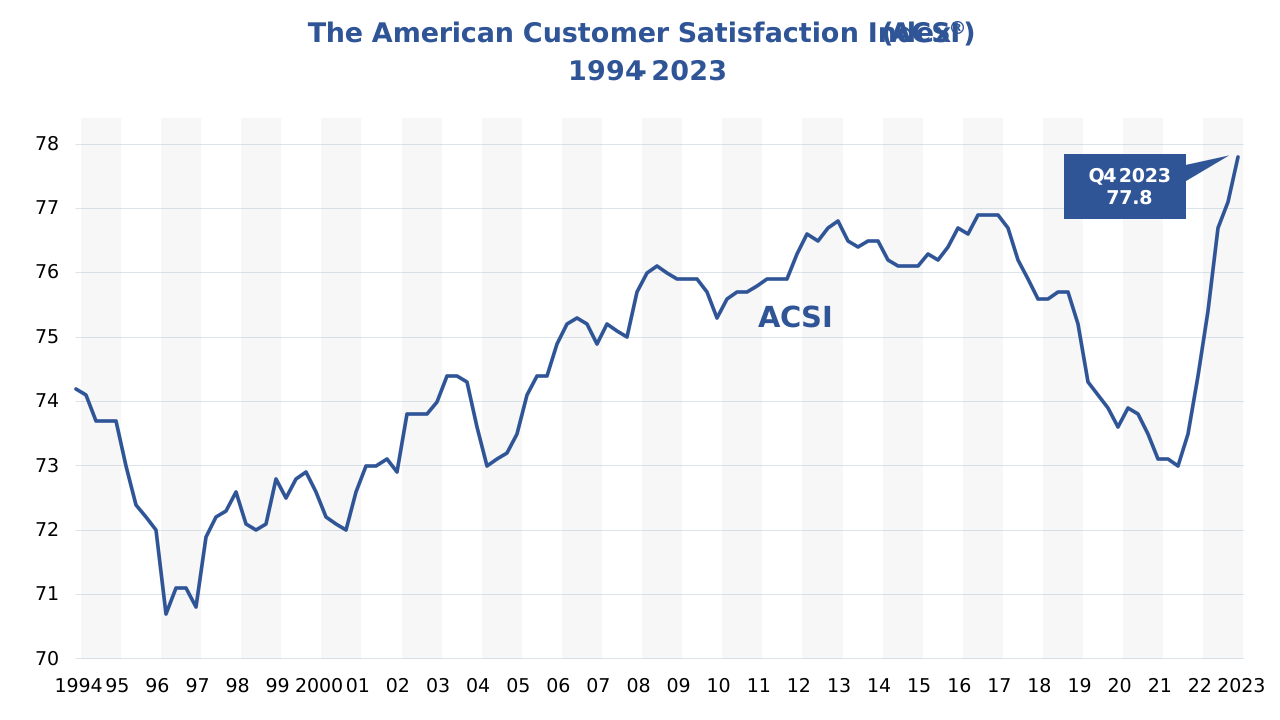
ACSI is up by 0.40% to an overall score of 75.2 - the highest ever.  But all signs are not favorable. In addition to the fact that there are more decliners than advancers, the rate of improvement in satisfaction has slowed.  It is also true that quality, as experienced by customers continues to lag improvements in customer satisfaction.  Instead, the rise in customer satisfaction is mostly due to low prices.  This may seem contradictory to the recent increases in the Consumer Price Index (CPI), but CPI did not increase much at the beginning of the year and the high CPI number for March was mostly limited to food and energy.  Core inflation was not up by much. But if the increase in quality is minor and ACSI growth is driven mostly by lower prices, or an absence of price increases, satisfaction becomes vulnerable to more volatility because prices change much quicker than quality. The weakening of the dollar may also put pressures on price.  Unless customer satisfaction improves further, there may also be additional pressure on profit margins.  Pricing power depends on upward shifting demand curves.  But an upward shift is unlikely unless there is shrinking supply or higher levels of buyer satisfaction.  There are no signs of the former in most industries, so the latter becomes more critical.

The relationship between consumer spending and ACSI continues to be strong.  While most forecasters predicted a weakening of consumer spending in the final quarter of 2006 and also for the first quarter of 2007, ACSI data pointed to an increase in spending growth of 3.5% to 4.1%. Actual first quarter growth was 3.8%, in the middle of that range. The forecast for the second quarter is continued spending growth, but at a more modest level.  Depending on the impact of the household debt service burden, the forecast would be in the range of 3.1% to 3.9%.

q1_07_comm_chart2

Airlines and Hotels:  The Trouble with Travel
Trouble continues for the travel-related industries. The same problems that have pulled airline passenger satisfaction down the past few years - disenchanted employees, increasing fuel costs, bankruptcy, and now also record levels of lost, delayed, and damaged luggage - cause it to drop again. The ACSI score for airlines falls 3% to 63, its lowest level in 7 years.

Falling 8% to 59, Delta's problems are not likely to go away. Two years ago, the airline filed for Chapter 11 bankruptcy. Since then, Delta has cut labor costs across the board and has now managed to emerge from Chapter 11, but this has come at a high price. In general, it is very difficult to reduce labor costs and increase customer satisfaction at the same time.  It usually means less service. Chances are that disaffected labor has been a contributing factor in the large drop in passenger satisfaction. United Airlines suffers an even larger fall in satisfaction. Down 11% to 56, United is now the lowest scoring airline by a substantial margin. Like Delta, United also emerged from bankruptcy with the same type of cost-cutting, renegotiation of employee contracts, and termination of pension plans. In general, ACSI scores in the 50's are not sustainable.  Delta and United may be out of bankruptcy, but they are now facing more problems with passengers.  Unless these problems are resolved, the future does not look bright.

As usual, Southwest Airlines stands apart from the rest. Up 3% to a score of 76, Southwest leads the airline business in passenger satisfaction and profitability. With no assigned seating, a quirky-fun corporate culture and a business model of limited, manageable growth, Southwest has a recipe for combining passenger satisfaction and financial success that has eluded its competitors.

The hotel industry also falls, down 5% to 71, its lowest score since 2002. Most of this, however, is due to a decline among smaller hotel chains.  Marriott is a bright spot. The highest scoring company in the hotel business is up 5% to 79 - its best score since 1994. Marriott has invested in many improvements to its properties, including renovations to its Courtyard and Residence Inn locations. The hotel has begun adding LCD televisions to many of its rooms, and has spent almost $200 million on better sheets and tops for its beds. These improvements show up in Marriott's ACSI data, and are major contributors to the gain in satisfaction. While the hotel's guests consider value for money about the same as last year, they deem the quality of Marriott's services to be significantly improved. Even though it had a large drop recently, Marriott's stock return is also well above market.

Fast Food and Full-Service Restaurants: A Wide Range
The fast food industry is unchanged this year at 77. Only one restaurant, Pizza Hut, registers a significant change - its customer satisfaction score drops by 5% to 72.  It looks like the co-branding of Pizza Hut with other YUM! restaurants - especially Taco Bell - might be eroding the Pizza Hut brand in the sense that it is becoming less a dine-in and more a traditional fast food restaurant.

Although fast food restaurants continue to do well by their customers, offering good value for money as their customers see it, this year's addition of full service restaurant chains shows that these types of eateries do even better. The full service or "casual dining" restaurants score significantly higher, with an average of 81. Olive Garden leads the industry at 80. With its all-you-can-eat salad and breadsticks special, Olive Garden brings an Americanized version of traditional Italian cuisine to malls and plazas across the United States. Chili's is at the bottom of the industry with a score of 75. Chili's ACSI data looks much more like that of a fast food restaurant than the other full service restaurants. While its value offering is comparable to the other casual dining establishments, it lags significantly behind in both product and service quality. Importantly, Chili's also comes in last in customer expectations, indicating that a reputation for comparatively less quality is impacting its image with consumers even before they walk in the door.

Cable/Satellite TV:  Where Customer Satisfaction Matters Less (for Earnings)
After a minor gain in 2006, the first ever for the industry, satisfaction among subscribers to cable and satellite TV service drops 2% to 62, the lowest level of customer satisfaction among all industries covered by ACSI.  None of the providers has improved on customer satisfaction this year.  Comcast (down 7% to 56), DirecTV (down 6% to 67) and Time Warner Cable (down 5% to 58) tumble.  High system loads causing problems with reliability and pricing were major culprits.  Both Comcast and Time Warner have acquired many new subscribers in their deal to divide up troubled cable provider Adelphia Communications - integrating these acquisitions often leads to short-term problems with customer satisfaction.  Another problem appears to be the industry's bundling of Internet, telephony and cable offerings.  A year ago, ACSI data suggested that price discounting for bundling gave the industry a boost in satisfaction, but poor reliability may reverse such an effect over time: customers with telephony and cable TV lose both services when there is a disruption. Cable TV providers Cox Communications and Comcast are also present in the fixed line telephone industry. Both drop in satisfaction, Cox by 8% to 70, Comcast by 3% to 67.

There seems to be an element of monopoly-like pricing in the cable industry: basic cable services rose 5 percent in 2006 and 93 percent over the past decade, nearly four times the rate of overall consumer prices during the period.  Such pricing power usually comes with some level of monopoly protection and most cable companies have little competition at the local level. This also means that a cable company can do well financially even though its customers are not particularly satisfied. Comcast is one of the lowest scoring companies in ACSI.  As its customer satisfaction eroded by 7% over the past year, revenue increased by 12%.  Net income went up by 175% and Comcast's stock price climbed nearly 50%.  In the first quarter this year, Comcast added 75,000 new cable TV subscribers, a 49% increase, and posted an 80% rise in earnings over the previous first quarter. 

Wireless Telephone Service: Moving Up
Although satisfaction with wireless telephone service remains well below the national average, a second year of improvement puts the industry at an all-time high: up 3% to a score of 68.  AT&T Mobility, the new incarnation of Cingular Wireless, makes a big jump, up 8% to 68, while Verizon Wireless and T-Mobile show gains of 3% and 1%, respectively.  The improvement in satisfaction over the past two years is the result of better quality of service and greater consumer choice.  Because number portability has made it somewhat easier for customers to switch providers, wireless service companies now have to work harder to keep customers.  Still, cancellation fees for breaking service contracts and the need to replace handsets when signing-up with a new carrier are considerable barriers to switching which allow the industry to continue with lackluster customer satisfaction: even with this year's gain, wireless service remains one of the five lowest scoring industries in ACSI.

As in several industry categories this quarter, not all companies move in the same direction.  Sprint Nextel is the exception in wireless.  Sprint used to be among the low scoring ACSI firms and its acquisition of even lower-scoring Nextel two years ago made matters worse. Nextel's network problems and outdated phones were major contributors.  Satisfaction with Sprint is falling well behind competition, from on par with the industry in 2005 to 10% below by 2007.  Sprint now stands at 61, a 3% drop from a year ago.  Customers are defecting and financials are taking a beating:  more than 300,000 high-end subscribers canceled service in the fourth quarter of 2006 and stock price fell by 20%, costing shareholders more than $10 billion.  Sprint's customer satisfaction may now be too low - so far below competition that subscribers may be willing to pay the price associated with switching to somebody else.

Computer Software:  Microsoft Falls
A year after its inclusion in ACSI, the computer software business is statistically unchanged, down 1% to 73, but Microsoft has dropped by 4% to 70. A year ago, the world's leading software producer was even with the rest of the industry; now it is behind in customer satisfaction. Much of this seems to have to do with its new operating system, Windows Vista, and the new Office Suite which were both released in January.  While shipments of new personal computers in 2007 come with Vista already installed, many users of Microsoft operating systems have had to purchase software to upgrade.  As always, there is a learning curve associated with new or revised software features.  There are compatibility issues and many other glitches requiring software patches and more frequent contacts with customer service, all of which make it more difficult to serve customers well.

Express Delivery: Rate Hikes Dampen Satisfaction across the Industry
Express delivery companies, from the largest players FedEx and UPS to the smaller providers, decline slightly.  The category falls 2% this year to 81.  FedEx and UPS also decline by 2% to 84 and 81 respectively, while the collection of smaller firms like DHL and Airborne Express slips 4% to 79.  Rate hikes by all the major companies are pulling down satisfaction across the board, but helping financials.  Revenue for FedEx is up 10% with a 25% growth in net income, while UPS improved its revenue by 12% with an increase of 9% in net income.

Utilities:  A Very Mixed Picture
Customer satisfaction with energy utilities improves slightly to 73, up 1%.  A milder winter in many parts of the country and an easing of natural gas prices created better value for money.  With prices dropping and less natural gas needed for heating, utilities that offer natural gas service only or in combination with electric service gain the most.

Ameren records a huge fall in customer satisfaction, down 23% to 57, one the largest drops in ACSI regardless of industry or time period.  Ameren's difficulties began at the end of 2005 when a dam owned by the company collapsed in Missouri, but last year also brought more challenges in the form of record-breaking winds and storms in both Missouri and Illinois - one of which set a record for the number of power outages. This alone would lead to a difficult service environment, but Ameren also had rate increases such that some customer bills increased by 100% to 300%. Major outages in Southern California during parts of 2006 also hurt Edison International (down 5% to 74), when customers encountered longer delays in restoring service.  Overall, however, most utilities have higher levels of customer satisfaction this year.

Hospitals: Satisfaction at All-Time High  
Patient satisfaction with hospitals improves 4% for a second straight year to reach an all-time high of 77.  In the fourth quarter of 2006, ACSI data showed an improvement in health care insurance resulting from a slower rate of growth in insurance premiums and drug costs.  Better value for money for health care, more outpatient vs. inpatient handling of treatments and procedures, and hospital initiatives to offer better quality of care appear to be contributing to the higher satisfaction with hospitals.

Newspapers:  Fewer Readers Mean Higher Satisfaction
Satisfaction with newspapers improves at a time when many papers are downsizing staffs, cutting costs, and circulation continues to go down.  The newspaper business is up 5% to 66 from a year ago, while daily print circulation is down 2.5% and Sunday circulation is down 3.1%. It may seem paradoxical that subscriber satisfaction goes up when readership goes down, but what has happened is that newspapers are losing their least satisfied customers. Customers who stay are more satisfied on the average.