Fourth Quarter 2006
| ACSI Quarterly Commentaries Q4 2006 |
|
|
Retail Trade; Finance & Insurance; E-Commerce
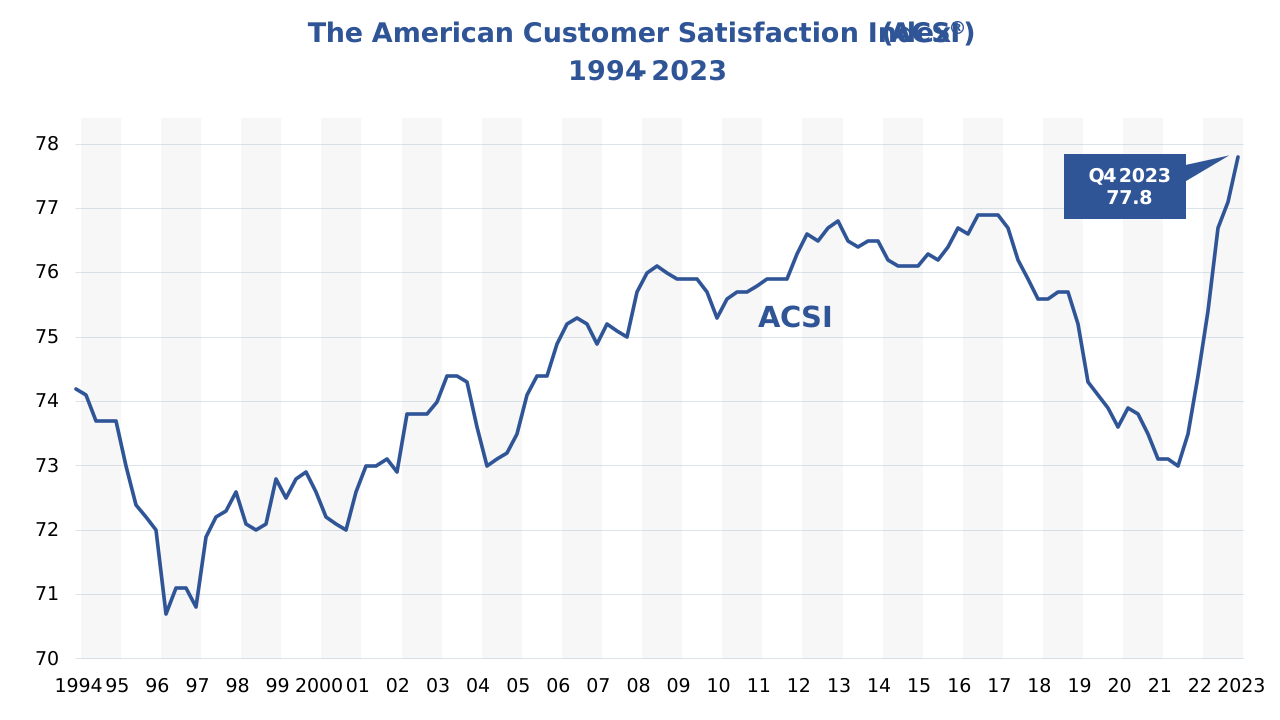
Customer Satisfaction at an All-Time High; Home Depot Makes U-Turn, Best Buy Gains; MetLife ReboundsThe American Customer Satisfaction Index (ACSI) continues its upward climb. For the fourth quarter of 2006, the Index reaches a new record high of 74.9 - an improvement of 0.7% over the previous quarter.
The increase is as broad as it is deep. Of the 13 industries measured in the fourth quarter, 9 show improvements, 2 are unchanged and 2 register declining scores. Supermarkets, gasoline service stations, specialty retail stores, health and personal care stores, commercial banks, life and health insurance, and e-commerce retailers and brokerages are all up - from 1.4% (for supermarkets and specialty retailers) to 5.9% (for health insurance). With falling oil prices, rising wages, a record low savings rate, little inflation, high consumer confidence, stable interest rates, low unemployment, and now also the highest customer satisfaction level ever recorded by ACSI, it is not surprising that consumer spending is unusually strong and has helped lift the overall economy. Most economic forecasts predicted a weakening of consumer spending for the final quarter of 2006. ACSI was virtually alone in suggesting solid growth, but not quite at the rate it turned out to be. American consumers continue to spend money as if there is no tomorrow. Households spent more than they earned in 2006 by borrowing more and/or dipping in to their savings. Under such circumstances, the traditional predictors of future spending - income and wealth - hold less sway. Rather, spending is becoming more dependent on the gratification consumers learn to expect from their consumption. This is why customer satisfaction has become an increasingly potent factor in determining household spending and short term GDP growth.
Over the past year, ACSI has risen by almost 2% - a very large change for this type of index. Even though customer satisfaction went up in 2005 as well, its rate of growth was more timid and consumer spending growth was weak. Spending picked up by mid 2006 only to fall back again before its rise at the end of the year. Looking at the total picture, the imbalances in the economy remain, but as far as the short-term outlook is concerned, the hope for a soft landing for the economy is beginning to look less likely. Without a significant reduction in consumer spending, it seems more probable that there won't be any landing at all. Although the economy might not soar, it will continue to show solid growth as long as foreign investors remain willing to fund U.S. household consumption and as long as oil prices, interest rates, or inflation don't dramatically change for the worse. The ACSI equations forecast continued growth in consumer spending between 3.5% and 4.1% for the first quarter of 2007. The most obvious caveat here would be that a short term spending hike, such as the one of the fourth quarter, is often followed by a short term retreat. But overall, the data suggest continued solid growth.
Retail: Home Depot Reverses Course as Lowe's Falls; Best Buy has Biggest Gain While almost every industry improves this quarter, department and discount stores decline slightly, down 1% to 74, driven largely by a 4% decline among the "all others" category of smaller stores and a 4% deterioration by Federated Department Stores Merger activity often plays havoc with customer service, particularly if cost reduction is a major objective. It usually leads to the closing of some outlets, reshuffling and elimination of brands, and changes in customer service personnel. It is difficult to ascertain what the culprit might be for Federated, but the company acquired May Department Stores in one of the largest mergers of 2005. The large reorganization that has followed may well have something to do with the drop. Another big decliner is the Department of Defense's Army & Air Force Exchange Service, down 5% to 70. The military exchange had strong sales and served more customers during the holiday season but did not increase staffing, which may have contributed to problems with customer service. In contrast to department and discount stores, supermarkets improve slightly, up 1% to 75. Consumers see more value for money and this is the prime driver behind the growth in satisfaction. Publix remains the industry leader with a gain of 3% to an all-time high of 83, well above the competition. The company is partly employee-owned and has long had a reputation for good customer service and a family-friendly atmosphere. Other major chains are up this year as well, including Kroger (+3% to 76), Winn-Dixie (+4% to 76) and Safeway (+4% to 74). The one exception is Supervalu, which drops 4% to 74, matching its all-time low - a likely result from getting a group of less satisfied customers from its acquisition of Albertson's grocery chains. Supervalu's challenge will be to improve the old Albertson's stores to the higher levels of satisfaction Supervalu has enjoyed. Costco retains its top position among specialty stores, with an improvement of 3% to 81, and maintains its lead over Sam's Club, which has also advanced by about the same amount and is now at 78. But the largest gain is posted by Best Buy, up 7% to 76. Best Buy continues to add a large number of stores per year - something that usually makes customer service more difficult to manage. But Best Buy seems to have risen to the challenge and has even succeeded in improving customer satisfaction in times of high growth. It appears that the company's mix of top-line products and extensive service offerings is paying off. Another reason for the strong ACSI result is that Best Buy sells many products that in and of themselves lead to high levels of customer satisfaction. Large household appliances fall into this category. Circuit City, by contrast, with a score of 69 - much below that of Best Buy - concentrates more on personal computers and products that demand higher levels of customer service with lower customer satisfaction to boot. Home Depot and Lowe's have come to represent two contrasting strategies in the home improvement retail segment. Home Depot began as a decentralized organization that favored full-time personnel, knowledgeable sales people and personalized service. After Home Depot's original management left in 2001, the company changed dramatically, especially in the way it was managed and how it came to embrace much more of a productivity orientation and a top down management approach. In 2001 Home Depot and Lowe's had identical ACSI scores. Four years later, the situation was very different. Lowe's had improved the satisfaction of its customers while Home Depot's customer relationships had deteriorated. By 2005 the gap between the companies had grown very large with Lowe's at 78 and Home Depot at the bottom of the industry at 67. The changes in customer satisfaction were also reflected in the financial fortunes of the companies. Lowe's stock price soared by more than 200% while Home Depot's shares dropped 7% - an increasingly common example of stock market gains from satisfied customers and stock market penalties from serving customers poorly. However, this year's results may indicate that Home Depot has learned a lesson, but that perhaps Lowe's has forgotten it. Home Depot moves up by 5% to a score of 70. Lowe's drops by 5% to a score of 74, its lowest ever. In the summer of 2006 Home Depot invested $350 million in store operations, much of it for improving customer service by hiring more full-time personnel, providing greater levels of service training and creating an incentive program for employee rewards for outstanding customer service. Nonetheless, Lowe's continues to have a significant lead over Home Depot. The challenge will be how to keep this advantage as it expands the number of stores. Lowe's has opened many outlets (150 stores in both 2005 and 2006 with plans for a similar number in 2007), putting more strain on resources for customer service. It is interesting to note that Kohl's endured a similar decline in ACSI during a time of rapid store expansion, yet Kohl's has kept its position as the leader in customer satisfaction among discount stores. The drug store retail category is up 3% from a year ago, with two of the three measured chains, CVS and Rite Aid, showing improved scores. CVS improves 5% to 78, while Rite Aid improves 4% to 75. CVS, the store that fills more prescriptions than any other in the U.S. (although it lags rival Walgreen's in total sales), has been on a "shopping spree" of its own lately. In 2004 CVS purchased about 1300 locations from the Eckerd drug store chain, and in 2006 the company picked up another 700 stores, taking CVS to more than 6200 stores nationwide. CVS now has more locations than any company in the industry. While mergers and acquisitions often lead to customer service problems, the health & personal care stores industry may be an exception to the rule. Most drug stores are now highly interconnected through computer technology, allowing prescriptions to be refilled at any store, and more locations mean greater convenience. Rite Aid, on the other hand, may be benefiting from a streamlining of operations. The company has off-loaded some of its financially less successful outlets - stores purchased in the late 90's and, as a by-product, also some of its less satisfied customers. At the the same time Rite Aid is also following the same strategy as CVS -acquiring more outlets. The company has begun the process of purchasing some 1900 stores from the Jean Coutu Group. It will be interesting to see if Rite Aid is able to use these additions to increase customer satisfaction. Rising customer satisfaction can usually be traced to quality improvements - for services and for products. Price usually plays a secondary role. This year is different. The retail data show no change in quality. But consumers perceive prices and "value for money" as highly favorable. This is consistent with a CPI for the year of 2.5% combined with wages rising by 6.5%. It is also consistent with another major factor boosting both the satisfaction of the customer and GDP growth: the ease by which buyers and sellers can find each other. The advances in communications technology, economic globalization, and the widening use of the web to match buyers and sellers in all areas of business might be paying dividends here as well.
Finance: Banks, Life and Health Insurance Improve Commercial banks have enjoyed a strong run lately. After a three-year stint at a high score of 75, the industry gains 2.7% to a new all-time high of 77. Wachovia continues its tradition of strong satisfaction performance, up 1% to 80, and again leads the industry. No major competitor is even within 6 points of Wachovia. Also noteworthy is the big improvement for Wells Fargo. Up 8% to 72, Wells Fargo is no longer playing catch-up with the rest of the industry. A greater variety of product offerings (higher product quality) at lower prices (better value for money) is translating to higher satisfaction among Wells Fargo customers. More satisfied customers buying a greater number of banking products equal greater financial returns -for the year Wells Fargo posted the largest profit in the bank's 154 year history. Both the life and the health insurance industries make major strides. Up 5.3% and 5.9% respectively, these gains are attributable to improvements in quality as well as value. On the pricing front, although health care costs continue to climb, both health insurance premiums and drug costs grew at a slower pace in 2006. Among life insurers, MetLife is up 10% to 78, rebounding from a similar decline in 2005. Prudential also posts a strong, albeit smaller gain of 6% to 76, and the aggregate of smaller life insurers is up 5% to 80. The industry-wide improvement is the result of better perceived value for money. Premiums are declining as a result of increased competition and longer life expectancies. Customers are also increasingly moving away from more expensive permanent to less costly term life insurance policies.
E-Commerce: Amazon, Barnesandnoble.com lead; Online Brokerages Improve Amazon.com and Barnesandnoble.com continue to be among the highest scoring companies in the ACSI, regardless of industry, at 87 and 88 respectively. Amazon.com is by far the largest pure-play online retailer. For the company to retain such a high level of customer satisfaction while expanding far beyond its origins as a book seller is quite remarkable. Books don't require much service, whereas the opposite is true for the some of the products Amazon is offering now, which include things like electronics, automotive accessories, cameras, and software. Like the year before, Amazon continues to invest in customer service technology and continues to have extraordinarily high levels of customer satisfaction. But because many of these costs are not capitalized, it is typical for Amazon to have rising customer satisfaction, increasing revenue, but a drop in profits. The short term reaction from the stock market is usually negative. So too this year, when Amazon reported higher sales and a fall in profits. The stock price fell by 3%. Exactly the same thing happened last year, but the stock price took a slightly worse beating then. If history is a guide, the stock market will come around and demonstrate that Amazon's investment in its customers will pay off. eBay continues to lead among auction websites, although the company drops (insignificantly) this quarter, down 1% to 80. eBay does far more than serve as an auction site and now sells both new and used products, in 45,000 distinct categories, to a market of about 180 million registered users. The company continues to do well financially, with strong fourth quarter revenue and earnings.
Two companies make their debut this year in the online brokerage category are Fidelity and TD Ameritrade. Fidelity scores at the top of the industry at 80, tied with Charles Schwab, while TD Ameritrade comes in at 77. The category is up 3% from a year ago to 78. Both Schwab and E*Trade make strong gains - Schwab is up 8% to an all-time high of 80, while E*Trade improves 4% to 74. Despite the improvement E*Trade still lags the rest of the industry by a significant margin. |